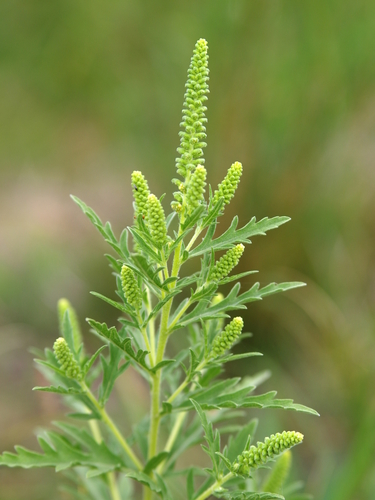


Western Ragweed
ambrosia psilostachya
Western Ragweed (Ambrosia psilostachya) is a ubiquitous and often abundant herbaceous perennial plant native to much of North America. Renowned for its robust growth and remarkable ability to rapidly colonize disturbed areas, it plays a critical ecological role in early successional stages, frequently being one of the pioneering species to establish itself in open, degraded soils. Its deep and spreading rhizomatous root system allows it to persist and thrive in challenging environments. While providing essential ground cover and contributing to soil stabilization in certain ecosystems, it is perhaps most infamous for its highly allergenic pollen. This characteristic makes it a primary culprit for seasonal hay fever (allergic rhinitis) for millions of people across the continent. Despite its notoriety as an agricultural weed and an allergen, Ambrosia psilostachya exhibits impressive resilience and adaptability, capable of flourishing in a diverse range of environmental conditions.
Lebensraum: Western Ragweed is typically found in disturbed habitats such as roadsides, agricultural fields, pastures, waste areas, prairies, and open woodlands, preferring dry to moist, well-drained soils.
This plant typically grows 30-100 cm tall, forming dense patches. Its stems are erect, hairy, and usually branched, often reddish or purplish at the base. The leaves are deeply lobed or dissected, giving them a finely cut appearance, and are grayish-green, feeling rough to the touch due to stiff hairs. Both sides of the leaves may have a slightly silvery sheen. The flowers are inconspicuous, borne in green-yellow spikes (racemes) at the tips of stems and in leaf axils during late summer and early fall. Male flowers are clustered above female flowers, which are found in the leaf axils below.
Kategorie
PflanzenSeltenheit
Common
Gefahr
1/5 · Sehr gering
Snaps
Mach den ersten Snap!
Despite its bad reputation for allergies, the seeds of ragweed plants are an important food source for many bird species, especially during winter months.
It's a resilient plant, capable of germinating and growing vigorously even in soils with low nutrient content, helping to stabilize disturbed ground.
The pollen of Western Ragweed is one of the most significant sources of autumn hay fever (allergic rhinitis) in North America, affecting millions of people.
Western Ragweed can be an indicator of disturbed or overgrazed land, as it thrives in areas where other more sensitive plants struggle.
Produces vast quantities of lightweight, wind-borne pollen, making it a highly effective disperser but also a significant allergen.
Possesses an extensive underground rhizome system, allowing it to rapidly colonize new areas and form dense clonal patches, outcompeting other vegetation.
Highly adapted to dry and arid conditions, enabling it to thrive in nutrient-poor or stressed environments where other plants might struggle.
As a photosynthetic organism, Western Ragweed produces its own food by converting sunlight into energy. It absorbs water and essential mineral nutrients from the soil.
Spinus tristis
Seeds provide food for granivorous birds.
Junonia coenia
Host plant for caterpillars.
Zygogramma suturalis
Herbivore that feeds on foliage.
Andropogon gerardii
Competes with native grasses and forbs for resources.
Für dieses Objekt sind noch keine Merkmal-Badges vergeben.
Noch keine Alternativnamen vorhanden.
Sammlungen für dieses Objekt erscheinen hier, wenn weitere Themen hinzugefügt werden.
Gefahr
1/5 · Sehr gering
Noch keine besonderen Sicherheitshinweise.
Der einfachste Weg, Western Ragweed zu bestimmen, ist die Verwendung der Naturführer-App Snappit.
30-100 cm
0.1-0.5 kg
1-5 Jahre
As a photosynthetic organism, Western Ragweed produces its own food by converting sunlight into energy. It absorbs water and essential mineral nutrients from the soil.
Western Ragweed is typically found in disturbed habitats such as roadsides, agricultural fields, pastures, waste areas, prairies, and open woodlands, preferring dry to moist, well-drained soils.
Absorption And Photosynthesis
Zoome hinein, um Cluster aufzulösen und zu sehen, wo dieses Objekt fotografiert wurde.
Neueste Snaps erscheinen hier, wenn neue Beobachtungen hinzukommen.




_BHL23630333.jpg&width=800)