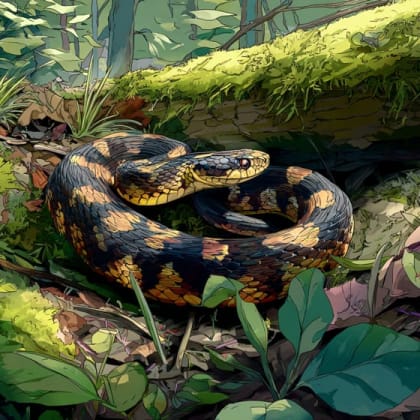
Western Ratsnake
Pantherophis obsoletus
The Western Ratsnake is a long, slender snake that can be black, gray, or brown. They are great climbers and often found in trees, making them fun to watch as they explore their surroundings!
Lebensraum: Forests
The Western Ratsnake is a large, non-venomous snake with highly variable coloring, often dark brown or black in adults, sometimes with faint blotches. Young snakes are typically gray with darker blotches and stripes. Its body is slender and muscular.
Kategorie
ReptilienSeltenheit
Common
Gefahr
1/5 · Sehr gering
Snaps
Mach den ersten Snap!
These amazing climbers can scale rough brick walls!
They sometimes freeze, kinking their body to perfectly mimic a broken branch!
Western Ratsnakes sometimes raid bird nests high in trees for eggs!
Young Western Ratsnakes look strikingly different with blotchy patterns!
Western Ratsnake can squeeze its prey because of its powerful muscles that helps them capture and subdue meals.
Western Ratsnake can climb high into trees and buildings because of its strong scales that helps them find nests or escape danger.
Western Ratsnake can vibrate its tail rapidly because of its specialized muscles that helps them sound like a venomous rattlesnake to scare threats.
Western Ratsnake has glands that produce a foul-smelling musk that helps them deter predators when they feel threatened.
This snake is a carnivore that primarily eats small mammals and birds, helping to control pest populations!
Altersunterschiede: Young snakes often eat more lizards and frogs before moving on to larger prey.
Peromyscus maniculatus
A common meal, especially for younger ratsnakes.
Microtus pennsylvanicus
A frequent target in grassy habitats.
Buteo jamaicensis
A common aerial predator of snakes.
Canis latrans
Opportunistically preys on snakes it encounters.
Einzelgänger leben den größten Teil ihres Lebens allein und interagieren mit Artgenossen nur zur Paarung oder zur Aufzucht der Jungen.
Baumbewohnende Tiere leben hauptsächlich in Bäumen und nutzen diese als Unterschlupf, Nahrungsquelle und zum Schutz vor Raubtieren.
Waldlebensräume sind terrestrische Lebensräume, die von dichtem Baumbestand dominiert werden und eine große Vielfalt an Pflanzen- und Tierarten beherbergen.
Dieses Merkmal kennzeichnet Organismen, deren Ernährung vollständig oder hauptsächlich aus tierischem Gewebe besteht.

Tagaktive Tiere sind hauptsächlich bei Tageslicht aktiv und ruhen oder schlafen in der Regel nachts.
Noch keine Alternativnamen vorhanden.
Gefahr
1/5 · Sehr gering
If you see a snake, it's best to watch from a distance and not touch it.
107-256 cm
0.5-2.5 kg
10-25 Jahre
3 km/h
This snake is a carnivore that primarily eats small mammals and birds, helping to control pest populations!
Forests
Ambush
5-20
Zoome hinein, um Cluster aufzulösen und zu sehen, wo dieses Objekt fotografiert wurde.
Neueste Snaps erscheinen hier, wenn neue Beobachtungen hinzukommen.