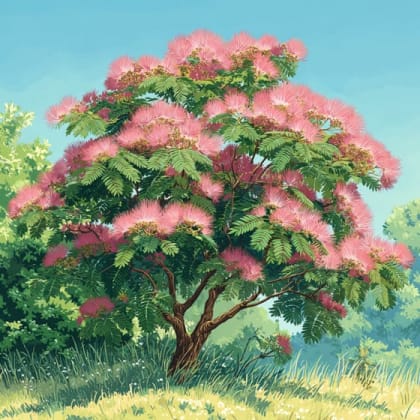
Western Red Cedar
Thuja plicata
The Western Red Cedar is a tall tree with soft, reddish-brown bark. It has flat sprays of scale-like leaves that smell fresh and woody. These trees are important to many animals in the forest.
Lebensraum: Forests
The Western Red Cedar is a towering evergreen with a broad, conical crown and distinctive reddish-brown, fibrous bark that peels in long strips. Its flat, scale-like leaves grow in drooping sprays, producing a strong, sweet aroma when crushed.
Kategorie
BäumeSeltenheit
Common
Gefahr
1/5 · Sehr gering
Snaps
Mach den ersten Snap!
Indigenous people harvested its soft bark to weave waterproof clothing and sturdy baskets.
Its scientific name, 'plicata', means 'folded', describing how its tiny leaves are arranged.
Western Red Cedars are the largest species in the cypress family, often growing super tall!
You can often spot tiny, shiny green cones, each only the size of a small fingernail!
Western Red Cedar has naturally rot-resistant wood that helps it stand strong for centuries even in damp environments.
Western Red Cedar can produce aromatic oils in its leaves and wood that help it defend against insects and fungi.
Western Red Cedar has supple branches that can bend under heavy snow, helping it avoid breakage during winter storms.
Odocoileus hemionus
Browses on young foliage and twigs.
Tamiasciurus douglasii
Eats seeds from its small cones.
Strix occidentalis
Nests in cavities of old-growth trees.
Rhizopogon vinicolor
Shares nutrients with its roots.
Schattenverträgliche Pflanzen sind an das Wachstum und Gedeihen in Bereichen mit wenig Licht angepasst und benötigen weniger direkte Sonneneinstrahlung.
Duftende Blüten verströmen ein angenehmes Aroma, oft um Bestäuber anzulocken oder zur Abwehr.
Immergrüne Pflanzen behalten ihr Laub das ganze Jahr über und werfen nie alle Blätter auf einmal ab.
Nadelgewächse sind in der Regel immergrün und tragen Nadeln oder Schuppen sowie Zapfen zur Fortpflanzung.

Nutzholz bezeichnet Holz, das für die Verwendung im Bauwesen und in der Zimmerei aufbereitet wurde.

Dieses Merkmal kennzeichnet Organismen mit einer außergewöhnlich langen Lebensspanne im Vergleich zu anderen ihrer Art.

Waldlebensräume sind terrestrische Lebensräume, die von dichtem Baumbestand dominiert werden und eine große Vielfalt an Pflanzen- und Tierarten beherbergen.
Dieses Lebensraummerkmal kennzeichnet Arten in gemäßigten Regenwäldern, die sich durch starke Niederschläge, milde Temperaturen und dichte immergrüne oder laubabwerfende Wälder in Küstenregionen auszeichnen.

Beschreibt eine Art, deren Anwesenheit und Rolle einen unverhältnismäßig großen Einfluss auf ihre Umwelt haben.
Gefahr
1/5 · Sehr gering
Enjoy looking at the majestic Western Red Cedars from a safe distance and avoid climbing them.
50-70 m
5-15 m
Nein
100-250 cm
500-1000 Jahre
Forests
Small woody cones
Mittel
Zoome hinein, um Cluster aufzulösen und zu sehen, wo dieses Objekt fotografiert wurde.
Neueste Snaps erscheinen hier, wenn neue Beobachtungen hinzukommen.