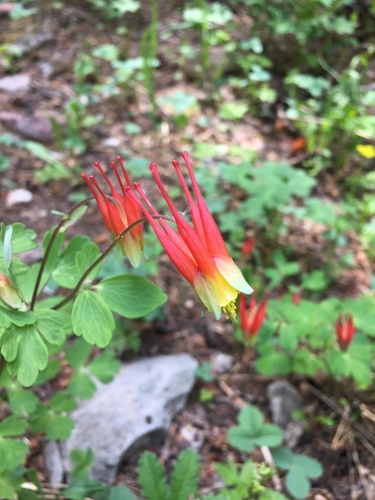


Western Red Columbine
aquilegia elegantula
The Western Red Columbine (Aquilegia elegantula) is a captivating perennial wildflower native to the high-elevation slopes and moist coniferous forests of the southern Rocky Mountains. Known for its elegant, nodding blossoms, this species plays a vital role in its montane ecosystem by providing early-to-midsummer nectar for native pollinators, especially migrating hummingbirds. Its intricate, spurred petals and delicate, divided foliage make it a favored sight for hikers exploring subalpine trails. This resilient plant thrives in partial shade and moist, gravelly soils, adding a splash of vibrant color to shaded canyons and rocky creeksides.
Lebensraum: Found in damp, rocky soils of coniferous forests, mountain canyons, and alpine meadows.
This slender wildflower grows up to sixty centimeters tall, characterized by nodding, pendant blooms featuring five long, straight red spurs pointing upwards and yellow petals forming an inner tube around protruding yellow stamens. The sepals are also bright red, contrasting beautifully with the yellow inner flower. Its delicate, bi- or tri-lobed compound leaves are a soft blue-green color and grow mainly near the base of the stem.
Kategorie
PflanzenSeltenheit
Common
Gefahr
1/5 · Sehr gering
Snaps
Mach den ersten Snap!
Its specific epithet, 'elegantula', is Latin for 'fine' or 'quite elegant', referencing its delicate, beautiful posture.
The genus name Aquilegia comes from the Latin word for eagle, referring to the spur petals that resemble an eagle's talons.
To prevent self-pollination, the plant's pollen-producing anthers mature and shed their pollen before the female stigma becomes receptive.
Features exceptionally deep nectar spurs that physically restrict access to all but long-tongued pollinators like hummingbirds, preventing nectar theft by short-tongued insects.
Produces cyanogenic glycosides within its tissues to discourage grazing by deer, rabbits, and other mountain herbivores.
Exhibits long, downward-protruding stamens that brush pollen onto the foreheads of hummingbirds while they feed, ensuring highly efficient cross-pollination.
As an autotrophic plant, it produces its own energy via photosynthesis, using sunlight, water, carbon dioxide, and essential nutrients absorbed through its root system.
Selasphorus platycercus
Feeds on nectar and acts as the primary pollinator for the flowers.
Phytomyza aquilegiae
Larvae mine tunnels through the leaves, feeding on internal plant tissue.
Für dieses Objekt sind noch keine Merkmal-Badges vergeben.
Noch keine Alternativnamen vorhanden.
Sammlungen für dieses Objekt erscheinen hier, wenn weitere Themen hinzugefügt werden.
Gefahr
1/5 · Sehr gering
Noch keine besonderen Sicherheitshinweise.
Der einfachste Weg, Western Red Columbine zu bestimmen, ist die Verwendung der Naturführer-App Snappit.
10-60 cm
3-10 Jahre
As an autotrophic plant, it produces its own energy via photosynthesis, using sunlight, water, carbon dioxide, and essential nutrients absorbed through its root system.
Found in damp, rocky soils of coniferous forests, mountain canyons, and alpine meadows.
Zoome hinein, um Cluster aufzulösen und zu sehen, wo dieses Objekt fotografiert wurde.
Neueste Snaps erscheinen hier, wenn neue Beobachtungen hinzukommen.

Colorado, US
Hier kann man sehen Regenbogenforelle, Bachforelle und Rotfuchs.
Führer anzeigen →

Colorado, US
Hier kann man sehen Broad-Tailed Hummingbird und Goldmantelziesel.
Führer anzeigen →

Colorado, US
Hier kann man sehen Schwarzschnabel-Elster und Zwillingsbeeren-Geißblatt.
Führer anzeigen →








_-_1970.355.140_-_Smithsonian_American_Art_Museum.jpg&width=800)

