

Whipple'S Penstemon
penstemon whippleanus
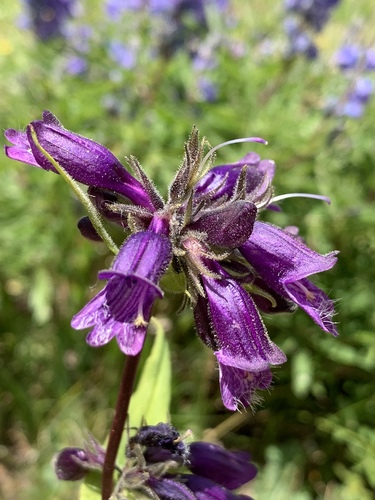
Whipple's Penstemon (Penstemon whippleanus), also known as Whipple's beardtongue, is a striking perennial wildflower native to the high-elevation regions of the western United States. Found gracing rocky subalpine slopes and alpine meadows, this resilient plant is famous for its distinctive, drooping clusters of deep purple to almost black, bell-shaped flowers. It plays a vital role in its montane ecosystem, providing crucial nectar for native bees and hummingbirds during the brief summer blooming season. Renowned for its ability to thrive in harsh, rocky soils where other plants struggle, it is a favorite among native plant enthusiasts and rock gardeners.
Lebensraum: Found in subalpine and alpine meadows, rocky slopes, and open coniferous forests of the western United States.
This herbaceous perennial typically grows between 20 to 60 cm tall, forming clumps of lance-shaped, green leaves at the base. Its most identifying feature is the nodding, tubular flowers clustered at the top of upright stems. The blossoms are usually a deep dusky purple, wine-red, or deep lavender, though creamy white variants occasionally occur. The lower lip of the tubular flower is famously hairy inside—a characteristic that gives 'beardtongues' their name—and often features delicate white or lighter-colored guide lines to direct pollinators.
Kategorie
PflanzenSeltenheit
Common
Gefahr
1/5 · Sehr gering
Snaps
Mach den ersten Snap!
The common name 'beardtongue' refers to the sterile stamen, which is heavily bearded with fine hairs, aiding in pollination.
This species was named in honor of Lieutenant Amiel Weeks Whipple, an American military officer and surveyor who led expeditions in the West.
While dark purple is the classic color for Whipple's Penstemon, entirely white or pale cream-colored flowers can occasionally be found in the same populations.
Adapted to withstand intense ultraviolet radiation, strong winds, and freezing temperatures characteristic of subalpine environments.
Possesses a fuzzy, sterile stamen (the 'beardtongue') that assists pollinators in positioning themselves while feeding.
Utilizes a deep, fibrous root system to access moisture deep within gravelly, well-draining soils.
As a photoautotrophic plant, Whipple's Penstemon generates its own energy through photosynthesis, utilizing sunlight, carbon dioxide, and water.
Bombus bifarius
Pollinated primarily by native bumblebees searching for nectar.
Euphydryas anicia
Serves as a host plant for the caterpillars of this western butterfly.
Ovis canadensis
Occasionally browsed by high-altitude herbivores when other food is scarce.
Für dieses Objekt sind noch keine Merkmal-Badges vergeben.
Noch keine Alternativnamen vorhanden.
Sammlungen für dieses Objekt erscheinen hier, wenn weitere Themen hinzugefügt werden.
Gefahr
1/5 · Sehr gering
Noch keine besonderen Sicherheitshinweise.
Der einfachste Weg, Whipple'S Penstemon zu bestimmen, ist die Verwendung der Naturführer-App Snappit.
20-60 cm
3-10 Jahre
As a photoautotrophic plant, Whipple's Penstemon generates its own energy through photosynthesis, utilizing sunlight, carbon dioxide, and water.
Found in subalpine and alpine meadows, rocky slopes, and open coniferous forests of the western United States.
Zoome hinein, um Cluster aufzulösen und zu sehen, wo dieses Objekt fotografiert wurde.
Neueste Snaps erscheinen hier, wenn neue Beobachtungen hinzukommen.

Colorado, US
Hier kann man sehen Great Basin Bristlecone Pine und Weidenröschen.
Führer anzeigen →

Colorado, US
Hier kann man sehen Elch, Wapiti und Whipple's Penstemon.
Führer anzeigen →

Colorado, US
Hier kann man sehen Broad-Tailed Hummingbird und Goldmantelziesel.
Führer anzeigen →

Colorado, US
Hier kann man sehen Virginia-Erdbeere, Schafgarbe und Schöne Jakobsleiter.
Führer anzeigen →