White-faced Saki
Pithecia pithecia
The White-faced Saki is a playful monkey with a fluffy white face and a long tail. They love to swing through the trees and eat fruits and seeds. These monkeys are very social and often live in groups!
Lebensraum: Forests
The White-faced Saki has long, shaggy fur, which is entirely black for females and young, while adult males sport a striking white or pale-yellow face contrasting sharply with their dark bodies. Their bushy, non-prehensile tails are about as long as their bodies.
Kategorie
SäugetiereSeltenheit
Common
Gefahr
2/5 · Gering
Snaps
Mach den ersten Snap!
Baby sakis cling tightly to their mother's belly for their first few months of life!
Male and female sakis look so different, people once thought they were different species!
These monkeys live almost entirely in the rainforest canopy, rarely touching the ground!
White-faced Sakis are shy, often staying hidden, making them tricky to spot.
White-faced Saki can jump up to 10 meters between trees using powerful legs, helping them escape danger and find food.
White-faced Saki has specialized teeth and strong jaws to crack open tough seeds, helping them access nutrient-rich food.
White-faced Saki has dark, shaggy fur, blending perfectly into rainforest shadows and dense foliage, protecting them from predators.
White-faced Saki can sleep hanging upside down by its feet, a unique posture helping them hide from canopy predators.
They munch on juicy fruits, crack open tough seeds, and sometimes snack on tasty insects!
Harpia harpyja
A powerful bird of prey in their canopy home.
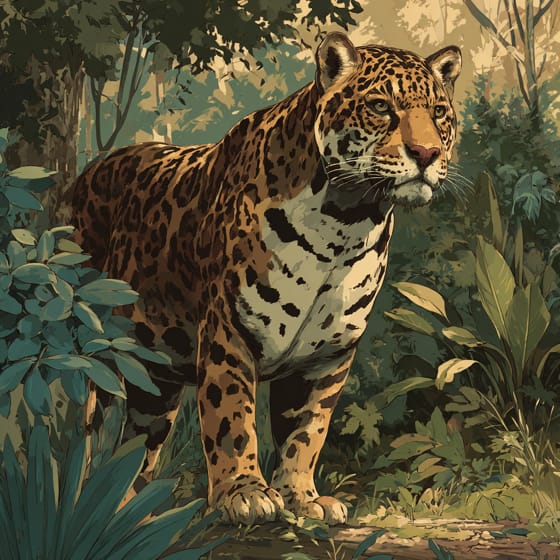
Panthera onca
A stealthy big cat that hunts in their forest.
Ficus insipida
They consume the fruits and seeds of this large fig.
Pouteria caimito
They enjoy the sweet, fleshy fruits of this tree.
Pelzig beschreibt Tiere, die eine dichte Schicht aus weichen Haaren oder Fell besitzen.
Soziale Tiere leben in organisierten Gruppen und kooperieren, um ihr Überleben zu sichern, beispielsweise bei der Nahrungssuche, Verteidigung und Aufzucht der Jungen.
Baumbewohnende Tiere leben hauptsächlich in Bäumen und nutzen diese als Unterschlupf, Nahrungsquelle und zum Schutz vor Raubtieren.
Dieses Merkmal kennzeichnet Lebewesen, deren Ernährung vollständig oder hauptsächlich aus pflanzlichem Material besteht.

Waldlebensräume sind terrestrische Lebensräume, die von dichtem Baumbestand dominiert werden und eine große Vielfalt an Pflanzen- und Tierarten beherbergen.

Dieses Merkmal kennzeichnet Lebewesen, die bei der Jagd, Flucht oder Fortbewegung eine außergewöhnliche Schnelligkeit aufweisen.

Tagaktive Tiere sind hauptsächlich bei Tageslicht aktiv und ruhen oder schlafen in der Regel nachts.

Der Status 'Stark gefährdet' bedeutet, dass eine Art in naher Zukunft einem sehr hohen Risiko ausgesetzt ist, in freier Wildbahn auszusterben.
Noch keine Alternativnamen vorhanden.
Gefahr
2/5 · Gering
Always watch from a distance and don't try to touch wild animals.
30-50 cm
1.5-2.5 kg
15-20 Jahre
25 km/h
They munch on juicy fruits, crack open tough seeds, and sometimes snack on tasty insects!
Forests
Foraging
1
Zoome hinein, um Cluster aufzulösen und zu sehen, wo dieses Objekt fotografiert wurde.
Neueste Snaps erscheinen hier, wenn neue Beobachtungen hinzukommen.