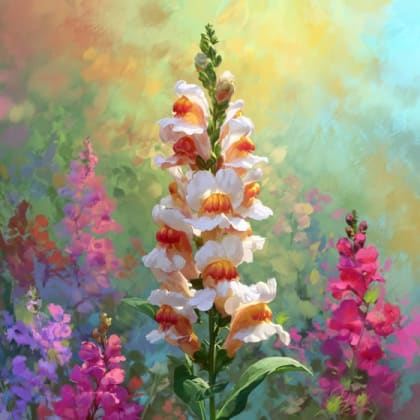
White nemophila
Nemophila heterophylla
The White Nemophila is a beautiful flower with delicate white petals and a cheerful look. It loves to grow in sunny places and can brighten up gardens and fields.
Lebensraum: Grasslands
The White nemophila has delicate, cup-shaped flowers, typically brilliant white. Its five petals are often adorned with subtle purple spots or dark veins near the center, creating a striking contrast. It visually differs from similar plants by these intricate markings and its low-growing habit.
Kategorie
PflanzenSeltenheit
Common
Gefahr
1/5 · Sehr gering
Snaps
Mach den ersten Snap!
Its name 'Nemophila' means 'lover of groves', because it likes shady, wooded spots.
Some white nemophila flowers have tiny purple spots or veins inside, like secret patterns!
The delicate white petals often form a shallow cup, perfect for catching morning dew.
These plants can grow so thickly they look like a soft, white carpet across the ground!
White nemophila can quickly produce and scatter its seeds, helping it spread widely and colonize new suitable areas each year.
This flower often has subtle lines or dots on its petals that guide insects directly to its nectar and pollen, ensuring efficient pollination.
White nemophila grows, blooms, and sets seed all within one season, allowing it to complete its life cycle quickly before conditions change.
Apis mellifera
collects nectar and pollen, aiding reproduction
Bombus vosnesenskii
visits flowers for nectar, helping spread pollen
Danaus plexippus
feeds on nectar, assisting in plant propagation
Blütenpflanzen sind alle Pflanzen, die als Teil ihres Fortpflanzungszyklus Blüten bilden.
Zierpflanzen werden hauptsächlich wegen ihres ästhetischen Reizes angebaut und verschönern Landschaften und Gärten mit ihrem attraktiven Laub, ihren Blüten oder ihrer Form.
Frühlingsblüher bilden ihre Blüten im Frühjahr und kündigen oft das Ende des Winters und den Beginn neuen Wachstums an.
Beschreibt Pflanzen, die für eine Vielzahl von bestäubenden Organismen besonders attraktiv und nützlich sind.

Grasland-Lebensräume sind terrestrische Biome, die von Gräsern und krautigen Pflanzen dominiert werden und einer Vielzahl von Weidetieren als Lebensraum dienen.
Noch keine Alternativnamen vorhanden.
Gefahr
1/5 · Sehr gering
Always look but don't pick flowers, so everyone can enjoy them!
10-30 cm
15-30 cm
1.5-3 cm
Frühling
Nein
Keine
Einjährig
Insekten
Zoome hinein, um Cluster aufzulösen und zu sehen, wo dieses Objekt fotografiert wurde.
Neueste Snaps erscheinen hier, wenn neue Beobachtungen hinzukommen.




.JPG)