

white pasqueflower
Pulsatilla occidentalis
The white pasqueflower is a beautiful flower that blooms in spring. It has soft, fluffy petals that look like little clouds and can often be found in grassy areas.
Lebensraum: Grasslands
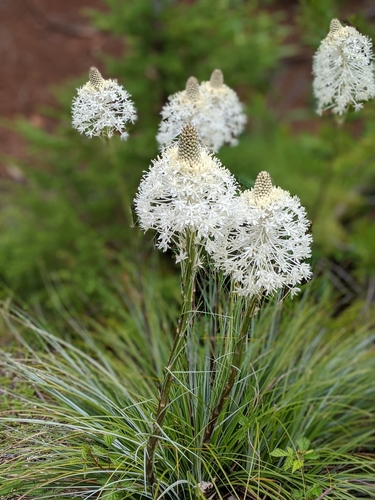
The white pasqueflower is a charming plant with cup-shaped, bell-like white flowers that often appear before its feathery, deeply cut leaves fully develop. Its stem and sepals are covered in soft, silken hairs, giving it a distinct fuzzy appearance.
Kategorie
PflanzenSeltenheit
Common
Gefahr
1/5 · Sehr gering
Snaps
Mach den ersten Snap!
After blooming, it develops super fluffy, silvery seed heads that look like wild hair!
It's often called a "gorilla flower" due to its remarkably fuzzy stems and blossoms!
Its scientific name, Pulsatilla, means "to pulsate" because its flowers gently sway in the wind!
The feathery tails on its seeds twist and screw themselves into the ground for planting!
white pasqueflower can emerge and bloom even when there's snow, helping it get a head start on pollination.
white pasqueflower has a dense covering of soft hairs on its stems and sepals that insulates it against cold temperatures.
white pasqueflower has distinctive feathery seed heads that catch the wind, helping its seeds travel far and wide.
white pasqueflower contains mild toxins that make it unappetizing to most grazing animals, helping it avoid being eaten.
Bombus bifarius
visits flowers for nectar and pollen
Andrena nivalis
one of the first bees active in early spring
Empis livida
important early spring pollinator in alpine areas
Blütenpflanzen sind alle Pflanzen, die als Teil ihres Fortpflanzungszyklus Blüten bilden.
Frühlingsblüher bilden ihre Blüten im Frühjahr und kündigen oft das Ende des Winters und den Beginn neuen Wachstums an.
Duftende Blüten verströmen ein angenehmes Aroma, oft um Bestäuber anzulocken oder zur Abwehr.
Winterharte Pflanzen können niedrigen Temperaturen und Frost ohne nennenswerte Schäden standhalten.

Beschreibt Pflanzen, die für eine Vielzahl von bestäubenden Organismen besonders attraktiv und nützlich sind.

Grasland-Lebensräume sind terrestrische Biome, die von Gräsern und krautigen Pflanzen dominiert werden und einer Vielzahl von Weidetieren als Lebensraum dienen.
Noch keine Alternativnamen vorhanden.
Gefahr
1/5 · Sehr gering
Do not touch flowers without asking an adult, as some can be harmful.
10-40 cm
15-30 cm
3-5 cm
Early spring to early summer
Nein
Mäßig
Mehrjährig
Insekten
Zoome hinein, um Cluster aufzulösen und zu sehen, wo dieses Objekt fotografiert wurde.
Neueste Snaps erscheinen hier, wenn neue Beobachtungen hinzukommen.
British Columbia, CA
Hier kann man sehen Common Beargrass, Subalpine Larch und Mountain Bog Gentian.
Führer anzeigen →

British Columbia, CA
Hier kann man sehen White Pasqueflower und Hoary Marmot.
Führer anzeigen →

British Columbia, CA
Hier kann man sehen White Pasqueflower und Columbian Ground Squirrel.
Führer anzeigen →

British Columbia, CA
Hier kann man sehen Green Comma, Trauermantel und Hoary Comma.
Führer anzeigen →

British Columbia, CA
Hier kann man sehen Western Rattlesnake Plantain und Shinyleaf Meadowsweet.
Führer anzeigen →