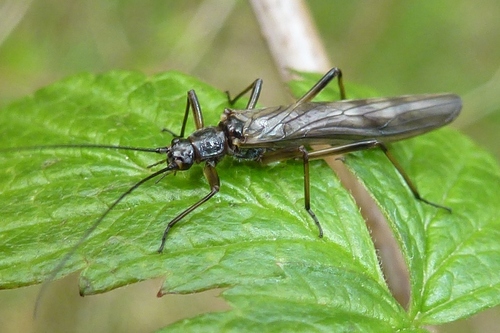


Winter Stoneflies
taeniopterygidae
Winter Stoneflies, belonging to the family Taeniopterygidae, are a unique group of insects celebrated for their remarkable adaptation to cold environments. Unlike most insects that hibernate or die off in winter, these resilient creatures emerge as adults during the colder months, often spotted crawling on snow or ice. Their life cycle begins in pristine, cold freshwater streams and rivers, where their aquatic nymphs thrive as crucial detritivores, breaking down organic matter. These fascinating insects play a vital ecological role, serving as both decomposers within freshwater ecosystems and a valuable food source for aquatic and terrestrial predators. Their presence is a strong indicator of water quality, making them biological sentinels of healthy stream environments.
Lebensraum: Winter Stoneflies are primarily found in clean, well-oxygenated freshwater streams and rivers, often with rocky or gravelly bottoms, and emerge as adults into riparian zones during colder months.
Adult Winter Stoneflies are typically small to medium-sized insects, ranging from 0.8 to 2.5 cm in body length. They generally exhibit subdued coloration, appearing dark brown, black, or grey, which provides effective camouflage against winter landscapes. They possess two pairs of membranous wings, which are typically held flat over their back when at rest, though some species may have reduced, non-functional wings. Key identifiers include their relatively stout body, long, multi-segmented antennae, and two distinct, often short, cerci (tail-like appendages) at the rear of the abdomen.
Kategorie
InsektenSeltenheit
Common
Gefahr
1/5 · Sehr gering
Snaps
Mach den ersten Snap!
Some species of Winter Stoneflies are known to "dance" on the surface of the snow or water to attract mates, producing vibrational signals.
The presence of Winter Stoneflies in a stream is a strong indicator of excellent water quality, as they cannot survive in polluted environments.
Their nymphs spend up to a year or more in streams, enduring frigid water temperatures before emerging to mate.
Winter Stoneflies are one of the few insect groups that are active as adults during the coldest parts of the year, often seen crawling on snow and ice.
Unlike most insects, Winter Stoneflies emerge as adults and reproduce during late winter and early spring, often on snow or ice, allowing them to avoid predation from warm-season insectivores and utilize niche environmental conditions.
Their aquatic nymphs are crucial detritivores, actively breaking down organic matter like decaying leaves and wood in stream beds, thereby helping to recycle vital nutrients within freshwater ecosystems.
Winter Stoneflies are highly sensitive to water pollution, particularly organic pollutants and reduced oxygen levels, making their presence a reliable bioindicator of pristine and healthy aquatic environments.
Winter Stonefly nymphs primarily feed on decomposing organic matter such as decaying leaves, algae, and detritus found in stream beds. Adult stoneflies typically have non-functional mouthparts and do not feed or consume very limited amounts of algae or lichen, focusing their short adult lives on reproduction.
Altersunterschiede: Nymphs are active detritivores, whereas adults generally do not feed, or consume very little, dedicating their energy entirely to mating and egg-laying.
Salvelinus fontinalis
Nymphs are a primary food source for various aquatic predators in freshwater ecosystems.
Anisoptera spp.
Aquatic nymphs are prey for other larger predatory insects within the stream environment.
Cinclus mexicanus
Adults, though short-lived, can be preyed upon by insectivorous birds that forage near water bodies.
Quercus spp. (example tree)
The nymphs play a critical role in breaking down and consuming decomposing plant material in streams.
Für dieses Objekt sind noch keine Merkmal-Badges vergeben.
Noch keine Alternativnamen vorhanden.
Sammlungen für dieses Objekt erscheinen hier, wenn weitere Themen hinzugefügt werden.
Gefahr
1/5 · Sehr gering
Noch keine besonderen Sicherheitshinweise.
Der einfachste Weg, Winter Stoneflies zu bestimmen, ist die Verwendung der Naturführer-App Snappit.
0-2 cm
1-4 cm
0.000001-0.00001 kg
0-1 Jahre
Winter Stonefly nymphs primarily feed on decomposing organic matter such as decaying leaves, algae, and detritus found in stream beds. Adult stoneflies typically have non-functional mouthparts and do not feed or consume very limited amounts of algae or lichen, focusing their short adult lives on reproduction.
Winter Stoneflies are primarily found in clean, well-oxygenated freshwater streams and rivers, often with rocky or gravelly bottoms, and emerge as adults into riparian zones during colder months.
Foraging (nymphs)
Zoome hinein, um Cluster aufzulösen und zu sehen, wo dieses Objekt fotografiert wurde.
Neueste Snaps erscheinen hier, wenn neue Beobachtungen hinzukommen.









_(8988707577).jpg&width=800)

