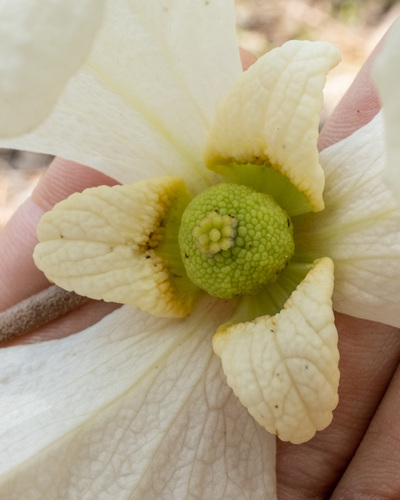


Woolly Pawpaw
asimina incana
The Woolly Pawpaw (Asimina incana), also known as the polecat pawpaw, is a charming, resilient dwarf shrub endemic to the sandy pine flatwoods and coastal plains of Florida and Georgia. Unlike its towering northern relative, this species stays close to the ground, reaching heights of only one to two meters. In early spring, it produces a spectacular show of large, pendulous white or cream-colored flowers that contrast beautifully with the charred undergrowth of its fire-prone habitat. This hardy plant is a vital component of the southeastern scrub ecosystem, serving as an evolutionary lifeline for local insect species. For native plant enthusiasts and wild foragers, the woolly pawpaw is a highly prized find, celebrated for both its ecological importance and its sweet, edible, banana-like fruits that mature in the heat of the summer.
Lebensraum: Found in dry, sandy soils of pine flatwoods, oak scrub, and sandhills throughout the southeastern United States.
This low-growing shrub is easily identified by its young twigs and leaves, which are covered in a soft, woolly, rust-colored or grayish pubescence. The leaves are oblong to obovate, growing up to 10 centimeters long with smooth margins. Its most striking feature is the large, nodding flower, boasting three large outer petals that are white to creamy-white, occasionally flushed with pink or purple at the base. The fruit is an oblong, green berry that turns yellow-green when ripe, measuring around 5 to 8 centimeters in length, resembling a small, plump banana.
Kategorie
PflanzenSeltenheit
Common
Gefahr
1/5 · Sehr gering
Snaps
Mach den ersten Snap!
Crushed leaves of this species release a highly unusual scent that has been described as a mix of gasoline, green peppers, and asphalt.
Despite its small size, the sweet, custard-like pulp of the woolly pawpaw fruit is fully edible and is a favorite snack of local forest wildlife.
The flowers of the woolly pawpaw emit a subtle, yeasty aroma that attracts flies and beetles for pollination rather than typical sweet-seeking bees.
It features a deep, robust taproot system that allows the plant to quickly resprout and bloom after frequent wildfire cycles.
The foliage produces potent chemical compounds called annonaceous acetogenins, protecting it from most herbivorous insects.
The dense, woolly hairs covering young leaves reduce water loss from transpiration under the intense subtropical sun.
As a photoautotroph, the woolly pawpaw synthesizes its own energy from sunlight via photosynthesis, drawing water and essential minerals through its deep root system.
Protographium marcellus
Serves as an essential host plant for caterpillars of the Zebra Swallowtail butterfly, which rely solely on pawpaw species for survival.
Gopherus polyphemus
Gopher tortoises sharing the sandy pine sandhills occasionally feed on the fallen, ripe sweet fruits of the woolly pawpaw.
Trichiotinus piger
Beetles crawl inside the scented flowers, feeding on pollen and effectively pollinating the shrub in a mutualistic relationship.
Für dieses Objekt sind noch keine Merkmal-Badges vergeben.
Noch keine Alternativnamen vorhanden.
Sammlungen für dieses Objekt erscheinen hier, wenn weitere Themen hinzugefügt werden.
Gefahr
1/5 · Sehr gering
Noch keine besonderen Sicherheitshinweise.
Der einfachste Weg, Woolly Pawpaw zu bestimmen, ist die Verwendung der Naturführer-App Snappit.
100-200 cm
10-30 Jahre
As a photoautotroph, the woolly pawpaw synthesizes its own energy from sunlight via photosynthesis, drawing water and essential minerals through its deep root system.
Found in dry, sandy soils of pine flatwoods, oak scrub, and sandhills throughout the southeastern United States.
Zoome hinein, um Cluster aufzulösen und zu sehen, wo dieses Objekt fotografiert wurde.
Neueste Snaps erscheinen hier, wenn neue Beobachtungen hinzukommen.

















