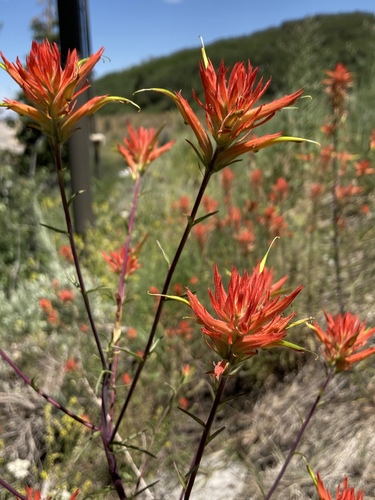


Wyoming Paintbrush
castilleja linariifolia
The Wyoming Paintbrush, also known as the linaria-leaved paintbrush, is a striking perennial wildflower famed for its vibrant, fiery-red to orange-yellow display. It is the proud state flower of Wyoming, widely celebrated for its ability to illuminate dry, rocky plains and mountain slopes. Uniquely adapted to arid conditions, this plant is hemiparasitic, meaning it produces its own energy via photosynthesis but actively taps into the root systems of neighboring plants, such as sagebrush, to steal water and vital nutrients.
Lebensraum: Found in dry, open plains, rocky foothills, and pinyon-juniper woodlands, often growing in close association with sagebrush shrubs.
This erect perennial grows between 30 and 100 cm tall, featuring sparse, slender, linear leaves that are deeply divided into narrow segments. The true flowers are tube-shaped and greenish-yellow, but they are mostly hidden by highly prominent, deeply lobed, scarlet-to-orange bracts that mimic brilliant blossoms. Its stems are often purplish-green and hairless to slightly hairy, terminating in showy, brush-like spikes that instantly catch the eye in dusty landscapes.
Kategorie
PflanzenSeltenheit
Common
Gefahr
1/5 · Sehr gering
Snaps
Mach den ersten Snap!
It was adopted as the official state flower of Wyoming on January 31, 1917, beating out other popular candidates like the columbine.
Native American tribes historically used the paintbrush as a condiment, love potion, and medicinal treatment for various ailments, though the plant can accumulate toxic levels of selenium from the soil.
The genus name 'Castilleja' honors Domingo Castillejo, an 18th-century Spanish botanist and instructor.
It utilizes specialized underground structures called haustoria to invade the roots of host plants, siphoning off water, nitrogen, and minerals to survive harsh droughts.
Instead of investing energy into large petals, it employs brightly colored leafy bracts to efficiently attract avian pollinators while retaining tough photosynthetic tissue.
Its narrow, thread-like leaves reduce surface area, significantly minimizing moisture loss through transpiration in arid environments.
As a hemiparasite, the Wyoming Paintbrush produces carbon sugars through its own photosynthesis, but supplements its water and mineral needs by tapping the roots of nearby host plants.
Artemisia tridentata
The paintbrush taps into the root system of big sagebrush to extract essential moisture and minerals.
Selasphorus platycercus
Broad-tailed hummingbirds are major pollinators of this plant, attracted by the bright red color of the bracts.
Euphydryas editha
The caterpillars of Edith's Checkerspot butterfly feed on the leaves and flowers, absorbing protective defensive chemicals from the plant.
Für dieses Objekt sind noch keine Merkmal-Badges vergeben.
Noch keine Alternativnamen vorhanden.
Sammlungen für dieses Objekt erscheinen hier, wenn weitere Themen hinzugefügt werden.
Gefahr
1/5 · Sehr gering
Noch keine besonderen Sicherheitshinweise.
Der einfachste Weg, Wyoming Paintbrush zu bestimmen, ist die Verwendung der Naturführer-App Snappit.
30-100 cm
3-8 Jahre
As a hemiparasite, the Wyoming Paintbrush produces carbon sugars through its own photosynthesis, but supplements its water and mineral needs by tapping the roots of nearby host plants.
Found in dry, open plains, rocky foothills, and pinyon-juniper woodlands, often growing in close association with sagebrush shrubs.
Parasitic Connectioning Via Haustoria To Host Plants, Primarily Sagebrush Or Pine Roots.
Zoome hinein, um Cluster aufzulösen und zu sehen, wo dieses Objekt fotografiert wurde.
Neueste Snaps erscheinen hier, wenn neue Beobachtungen hinzukommen.









.jpg&width=800)