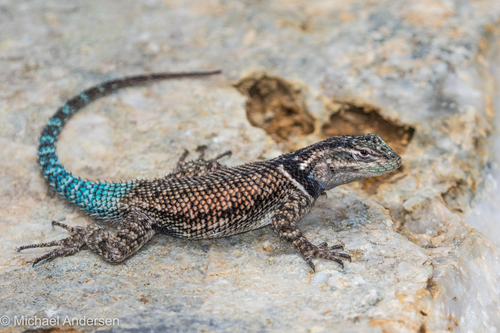


Yarrow'S Spiny Lizard
sceloporus jarrovii
Yarrow's Spiny Lizard is an exceptionally resilient and striking reptile native to the rugged mountainous regions of the southwestern United States and Mexico. Thriving in rocky canyons and oak-pine forests at high elevations, this lizard is celebrated for its remarkable adaptations to cold environments. Unlike many of its egg-laying relatives, this species gives birth to live young, which is a critical strategy for survival in frosty montane climates. Observing these lizards is a delight for nature enthusiasts as they are highly active during the day, frequently seen basking on boulder faces, rock crevices, or tree trunks. With a bold disposition, they defend territories using energetic push-up displays, revealing flashes of brilliant blue on their undersides. Their ability to tolerate chilly temperatures makes them one of the few reptiles active on sunny winter days, adding a touch of vibrant life to the mountain slopes year-round.
Lebensraum: Found in rocky montane habitats, such as canyon walls, talus slopes, and boulder piles within oak-pine forests at high elevations.
This medium-sized lizard is easily identified by its heavily keeled, pointed, and spiny scales that give it a rough, armored appearance. It features a conspicuous black collar around its neck, bordered by crisp white or light-yellow bands. The base coloration ranges from greenish-blue to dark grey, often speckled with pale blue, yellow, or green spots. Males are particularly stunning, sporting bright metallic-blue patches on their throat and the sides of their belly, which intensify during the breeding season. They reach an average total length of 11 to 24 centimeters, including their long, tapered tail.
Kategorie
ReptilienSeltenheit
Common
Gefahr
1/5 · Sehr gering
Snaps
Mach den ersten Snap!
Because they live in cold mountain heights, they can remain active even during sunny winter days when other reptiles are completely dormant.
They are known as mood ring lizards because they can rapidly change their color from dark charcoal to vibrant metallic blue depending on the temperature and their social interactions.
To defend their territory or woo mates, males perform rhythmic push-up displays, flashing their bright blue throat and belly patches to communicate from afar.
They can darken their skin in the cool morning hours to absorb more solar radiation, shifting to a lighter, reflective color as temperatures rise.
Unlike most lizards that lay eggs, they give birth to fully formed live young, protecting the embryos from freezing mountain temperatures.
When threatened by a predator, they can self-amputate their tail, which continues to wiggle and distract the predator while the lizard escapes.
They primarily feed on a wide variety of terrestrial insects and spiders, hunting actively along rocky surfaces during the day.
Altersunterschiede: Juveniles consume smaller soft-bodied insects like aphids and small flies, whereas adults can tackle larger, hard-shelled beetles and wasps.
Accipiter cooperii
Preys upon these lizards when they bask openly on exposed rock surfaces.
Camponotus sansabeanus
Serves as a high-abundance food source for the lizard on forest floors and rock crevices.
Urosaurus ornatus
Competes for basking spots, territories, and small insect prey in overlapping montane habitats.
Für dieses Objekt sind noch keine Merkmal-Badges vergeben.
Noch keine Alternativnamen vorhanden.
Sammlungen für dieses Objekt erscheinen hier, wenn weitere Themen hinzugefügt werden.
Gefahr
1/5 · Sehr gering
Noch keine besonderen Sicherheitshinweise.
Der einfachste Weg, Yarrow'S Spiny Lizard zu bestimmen, ist die Verwendung der Naturführer-App Snappit.
11-24 cm
0.01-0.04 kg
3-6 Jahre
15 km/h
They primarily feed on a wide variety of terrestrial insects and spiders, hunting actively along rocky surfaces during the day.
Found in rocky montane habitats, such as canyon walls, talus slopes, and boulder piles within oak-pine forests at high elevations.
Ambush
Zoome hinein, um Cluster aufzulösen und zu sehen, wo dieses Objekt fotografiert wurde.
Neueste Snaps erscheinen hier, wenn neue Beobachtungen hinzukommen.

Arizona, US
Hier kann man sehen Yarrow's Spiny Lizard und Mexican Jay.
Führer anzeigen →

Arizona, US
Hier kann man sehen Mexican Jay, Yarrow's Spiny Lizard und Weißwedelhirsch.
Führer anzeigen →

Arizona, US
Hier kann man sehen Broad-Billed Hummingbird und Mexican Jay.
Führer anzeigen →













