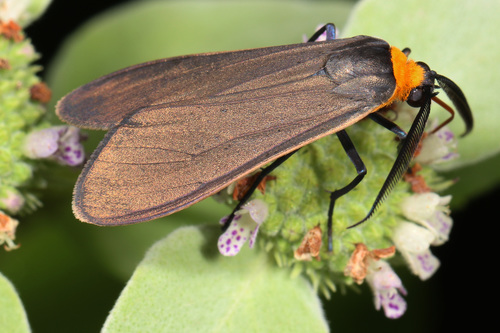


Yellow-Collared Scape Moth
cisseps fulvicollis
The Yellow-Collared Scape Moth (Cisseps fulvicollis) is a charming diurnal moth native to North America. Often mistaken for a wasp due to its slender profile, darkened wings, and behavior, this insect is a masterful mimic that uses its appearance to deter predators. It features a striking, bright orange-yellow collar that contrasts sharply against its velvety dark-brown or black body and smoky, semi-translucent wings. Unlike most moths that fly under the cover of darkness, this species is a frequent daytime visitor to meadows, fields, and gardens. It can often be observed gently fluttering from flower to flower, sipping nectar alongside bees and butterflies. This makes it an exceptionally accessible and delightful find for nature enthusiasts and backyard observers alike.
Lebensraum: Found in open fields, wet meadows, marshes, prairies, and suburban gardens where nectar-rich flowers and larval host plants are abundant.
The Yellow-Collared Scape Moth is easily identified by its distinctive, bright yellow-to-orange collar (pronotum) that encircles its neck. Its body and wings are primarily dark brownish-black, with the forewings being narrow and opaque, while the hindwings are slightly lighter and semi-translucent. It has a slender, metallic-blue abdomen that is often hidden when the wings are folded flat over its back in a tent-like fashion. Its antennae are bipectinate (feathery) in males and simple in females, and it typically has a wingspan ranging from 3 to 4 centimeters.
Kategorie
InsektenSeltenheit
Common
Gefahr
1/5 · Sehr gering
Snaps
Mach den ersten Snap!
Despite being moths, they are strictly diurnal (day-active) and are commonly found feeding alongside bees and butterflies.
Their orange collar is a form of aposematism, warning visual predators like birds that they might taste bad or be toxic.
They possess a specialized organ called a Johnston's organ at the base of their antennae to help them sense flight speed and wind direction.
It deters potential predators by mimicking the slender shape, dark coloration, and daytime flight patterns of stinging wasps.
Equipped with tympanic organs, it can detect the echolocation calls of bats, allowing it to take evasive maneuvers if flying near dusk.
As caterpillars, they feed on grasses and sedges, accumulating toxic compounds that make them distasteful to birds and other predators.
Caterpillars feed primarily on various grasses, sedges, and lichens, while the adult moths feed on the nectar of diverse flowering plants.
Altersunterschiede: Larvae are chewing herbivores that consume grass blades and lichens, whereas adults possess a siphoning proboscis restricted to liquid nectar.
Dactylis glomerata
Larval host plant where caterpillars feed on the leaves.
Solidago canadensis
Adult moths obtain energy-rich nectar from the blossoms.
Cyanocitta cristata
Predatory birds that occasionally feed on caterpillars or adults despite their warning colors.
Für dieses Objekt sind noch keine Merkmal-Badges vergeben.
Noch keine Alternativnamen vorhanden.
Sammlungen für dieses Objekt erscheinen hier, wenn weitere Themen hinzugefügt werden.
Gefahr
1/5 · Sehr gering
Noch keine besonderen Sicherheitshinweise.
Der einfachste Weg, Yellow-Collared Scape Moth zu bestimmen, ist die Verwendung der Naturführer-App Snappit.
1+ cm
3+ cm
0.0001+ kg
8 km/h
Caterpillars feed primarily on various grasses, sedges, and lichens, while the adult moths feed on the nectar of diverse flowering plants.
Found in open fields, wet meadows, marshes, prairies, and suburban gardens where nectar-rich flowers and larval host plants are abundant.
Foraging
Zoome hinein, um Cluster aufzulösen und zu sehen, wo dieses Objekt fotografiert wurde.
Neueste Snaps erscheinen hier, wenn neue Beobachtungen hinzukommen.
















