






Yellow-headed Blackbird
Xanthocephalus xanthocephalus
The Yellow-headed Blackbird is a striking bird with a bright yellow head and a black body. They love to sing and can often be found near wetlands, making their cheerful sounds a delight to hear.
Lebensraum: Wetlands
The Yellow-headed Blackbird has a striking appearance, with males sporting an entirely black body, a bright yellow head and chest, and a distinct white patch on the wing. Females are duller, brownish-black with a yellow wash on the face and throat, and streaked underparts.
Kategorie
VögelSeltenheit
Common
Gefahr
1/5 · Sehr gering
Snaps
Mach den ersten Snap!
Male Yellow-headed Blackbirds fiercely defend their territory by puffing up their yellow feathers!
Their loud, raspy call sometimes sounds like a rusty gate opening!
These birds often nest in colonies with hundreds of other blackbirds!
Yellow-headed Blackbirds will sometimes steal nesting materials from other bird species!
Yellow-headed Blackbirds can build intricate cup nests because of their weaving skills, anchoring them to marsh plants.
This bird has a unique, reedy call that helps them communicate and attract mates within their large breeding colonies.
Yellow-headed Blackbirds can expertly forage for insects in marsh vegetation and fields, providing food for their young.
These birds munch on juicy insects and tasty seeds found in their marshy homes!
Altersunterschiede: Nestlings are fed almost exclusively insects, while adults have a broader diet of insects and seeds.
Buteo jamaicensis
Adults and fledglings can be prey.
Thamnophis sirtalis
Nests and young are vulnerable.
Typha latifolia
Nests are often built within dense cattail stands.
Anax junius
Forages for dragonfly larvae and adults.
Gefiedert beschreibt Tiere, hauptsächlich Vögel, die ein Federkleid besitzen.
Soziale Tiere leben in organisierten Gruppen und kooperieren, um ihr Überleben zu sichern, beispielsweise bei der Nahrungssuche, Verteidigung und Aufzucht der Jungen.
Farbenfroh beschreibt Organismen oder Objekte, die eine große Vielfalt an leuchtenden und deutlich erkennbaren Farben aufweisen.
Dieses Merkmal kennzeichnet Organismen, deren Nahrung hauptsächlich aus Insekten und anderen kleinen Wirbellosen besteht.

Dieses Lebensraummerkmal kennzeichnet Arten, die in Feuchtgebieten vorkommen. Dies sind Landflächen, die dauerhaft oder saisonal mit Wasser gesättigt sind, darunter Marschland, Sümpfe und Moore.

Tagaktive Tiere sind hauptsächlich bei Tageslicht aktiv und ruhen oder schlafen in der Regel nachts.
Noch keine Alternativnamen vorhanden.
Gefahr
1/5 · Sehr gering
Enjoy watching birds from a distance, and don't disturb their nests.
21-26 cm
40-45 cm
0.038-0.075 kg
6-8 Jahre
50 km/h
These birds munch on juicy insects and tasty seeds found in their marshy homes!
Wetlands
Foraging
Zoome hinein, um Cluster aufzulösen und zu sehen, wo dieses Objekt fotografiert wurde.
Neueste Snaps erscheinen hier, wenn neue Beobachtungen hinzukommen.
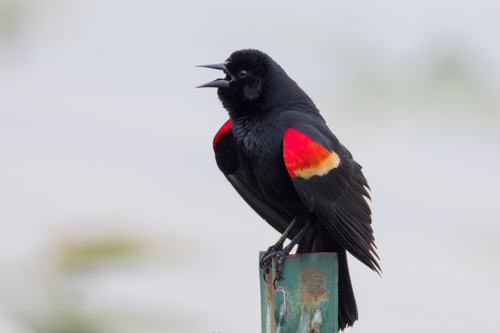
British Columbia, CA
Hier kann man sehen Rotschulterstärling, Sumpfschwalbe und Kanadareiher.
Führer anzeigen →
.jpg)
South Dakota, US
Hier kann man sehen Leopardfrosch, Rotschulterstärling und Dame's Rocket.
Führer anzeigen →










%2C_Playa_de_Boulders%2C_Simon%27s_Town%2C_Sud%C3%A1frica%2C_2018-07-23%2C_DD_11.jpg&width=800)
