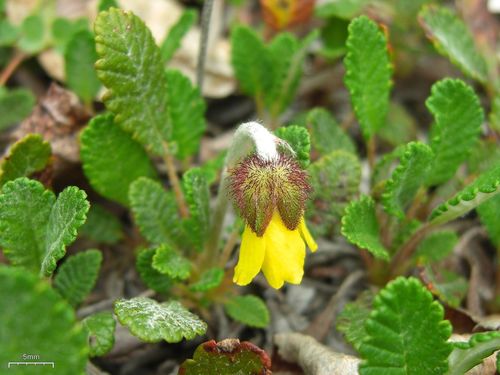


Yellow Mountain-Avens
dryas drummondii
The Yellow Mountain-Avens (Dryas drummondii) is a resilient, mat-forming woody dwarf shrub belonging to the rose family. Renowned for its ability to thrive in harsh, barren environments, this pioneering species is frequently one of the first plants to colonize newly exposed gravels left behind by retreating glaciers or shifting rivers. By forming symbiotic relationships with nitrogen-fixing bacteria, it plays a vital ecological role in enriching nutrient-poor soils, facilitating the gradual succession of richer plant communities. Its dense, creeping mats also help stabilize loose soils, preventing erosion along steep alpine slopes and dynamic river systems.
Lebensraum: Typically found on gravelly river flats, glacial moraines, scree slopes, and rocky alpine meadows.
This low-growing shrub is easily identified by its nodding, bell-shaped yellow flowers that bloom singly on upright, hairy stems. Unlike other mountain-avens, its petals remain somewhat closed, creating a cup-like appearance. Its leaves are oblong, dark green, and leathery with deeply scalloped edges, contrasting sharply with their woolly, silver-white undersides. As the flowers mature, they transform into spectacular, fluffy, feather-like seed heads that spiral elegantly to catch alpine winds.
Kategorie
PflanzenSeltenheit
Common
Gefahr
1/5 · Sehr gering
Snaps
Mach den ersten Snap!
It acts as a primary ecological builder, transforming barren, rocky debris into nutrient-rich soil that allows other plant species to colonize the area.
Its twisted, feathery seed heads act like miniature weather vanes, twisting tightly when wet and expanding when dry to release seeds in dry, windy conditions.
Unlike most other mountain-avens which have wide-open white flowers, the yellow mountain-avens has nodding yellow blossoms that never fully open.
Cooperates with Frankia bacteria in its root nodules to convert atmospheric nitrogen into a usable form, allowing it to survive on sterile gravel.
Produces feathery, plumose styles on its seeds that act as sails to maximize dispersal across barren post-glacial landscapes.
Establishes extensive, woody root networks and dense ground-hugging mats that bind loose gravel and prevent erosion.
As a photosynthetic plant, it generates its own energy using sunlight, carbon dioxide, and water, supplemented by nutrients fixed via root nodule symbiosis.
Frankia alni
Obtains crucial fixed nitrogen through a mutualistic relationship in its root nodules.
Oreamnos americanus
Graze on the leaves and stems of the dwarf shrub in high alpine habitats during the summer months.
Bombus occidentalis
Visits the nodding yellow flowers for nectar and pollen, acting as a key pollinator.
Für dieses Objekt sind noch keine Merkmal-Badges vergeben.
Noch keine Alternativnamen vorhanden.
Sammlungen für dieses Objekt erscheinen hier, wenn weitere Themen hinzugefügt werden.
Gefahr
1/5 · Sehr gering
Noch keine besonderen Sicherheitshinweise.
Der einfachste Weg, Yellow Mountain-Avens zu bestimmen, ist die Verwendung der Naturführer-App Snappit.
5-25 cm
10-50 Jahre
As a photosynthetic plant, it generates its own energy using sunlight, carbon dioxide, and water, supplemented by nutrients fixed via root nodule symbiosis.
Typically found on gravelly river flats, glacial moraines, scree slopes, and rocky alpine meadows.
Photosynthesis
Zoome hinein, um Cluster aufzulösen und zu sehen, wo dieses Objekt fotografiert wurde.
Neueste Snaps erscheinen hier, wenn neue Beobachtungen hinzukommen.