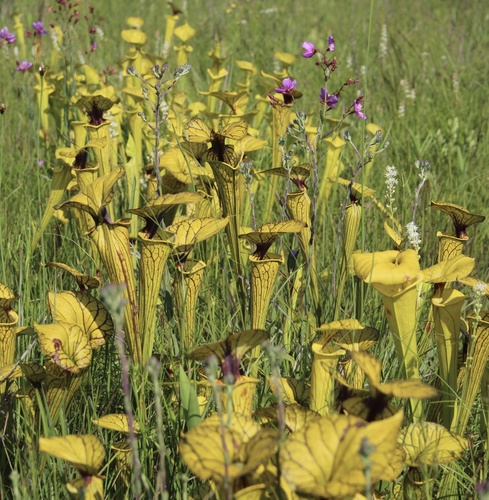


Yellow Pitcher Plant
sarracenia flava
The Yellow Pitcher Plant (Sarracenia flava) is a stunning and formidable carnivorous plant native to the southeastern United States. Thriving in boggy, nutrient-poor soils where most plants struggle, it has evolved a highly specialized method of supplementing its diet: trapping insects. Characterized by striking, towering tubes that rise elegantly from the wetland floor, the plant presents a beautiful but deadly facade to its prey. It attracts victims with vibrant colors and sweet, intoxicating nectar laced with paralyzing compounds. A true marvel of wetland ecosystems, the Yellow Pitcher Plant represents a fascinating evolutionary adaptation, turning the tables on the animal kingdom to survive in harsh, sun-drenched savannas and seepage slopes.
Lebensraum: Found in damp, acidic, nutrient-poor wetland habitats such as pine savannas, sphagnum bogs, and seepage slopes.
This species is easily recognized by its tall, erect, trumpet-shaped leaves (pitchers) that can reach up to a meter in height. The pitchers are typically vibrant yellow-green, frequently displaying striking red or maroon venation along the tube and the throat. An umbrella-like hood, or operculum, extends over the opening to shield the inner chamber from heavy rains. In early spring, before the pitchers fully mature, the plant produces large, distinctive yellow flowers featuring five drooping, slightly twisted petals atop tall, leafless stalks.
Kategorie
PflanzenSeltenheit
Common
Gefahr
1/5 · Sehr gering
Snaps
Mach den ersten Snap!
A single large pitcher can consume thousands of insects over its lifespan, sometimes filling all the way to the brim with digested, hollowed-out exoskeletons.
The plant's nectar contains coniine, the same poisonous alkaloid found in poison hemlock, which drug-dazes insects and guarantees their fatal slip.
These plants actually depend on natural wildfires; regular blazes burn away taller, competing vegetation that would otherwise block their sunlight without harming their underground rhizomes.
To prevent eating its own pollinators, the Yellow Pitcher Plant cleverly blooms in early spring on tall stalks, well before its deadly traps fully develop.
Its modified leaves form a deep, slippery funnel containing a pool of digestive enzymes and wetting agents to effectively drown and dissolve trapped insects.
The rim of the pitcher secretes a sweet nectar containing the paralyzing alkaloid coniine, causing feeding insects to become uncoordinated and tumble inside.
It features an overhanging leaf structure (operculum) that acts as a natural umbrella, preventing rain from diluting its precious pool of digestive fluids.
It catches and digests insects to extract vital nutrients, particularly nitrogen and phosphorus, which are largely absent from its native bog soils.
Altersunterschiede: Seedlings begin by catching microscopic prey like springtails and small gnats, slowly graduating to much larger insects as they produce taller pitchers.
Bombus impatiens
Safely pollinates the plant's flowers, which bloom well before the deadly pitchers open to avoid trapping their benefactors.
Exyra semicrocea
A specialized moth whose larvae feed safely on the inner tissues of the pitcher, sometimes causing the upper part of the leaf to collapse.
Dryophytes cinereus
Often perches just inside the mouth of the pitcher to steal incoming insects attracted by the plant's nectar.
Für dieses Objekt sind noch keine Merkmal-Badges vergeben.
Noch keine Alternativnamen vorhanden.
Sammlungen für dieses Objekt erscheinen hier, wenn weitere Themen hinzugefügt werden.
Gefahr
1/5 · Sehr gering
Noch keine besonderen Sicherheitshinweise.
Der einfachste Weg, Yellow Pitcher Plant zu bestimmen, ist die Verwendung der Naturführer-App Snappit.
30-100 cm
20-50 Jahre
It catches and digests insects to extract vital nutrients, particularly nitrogen and phosphorus, which are largely absent from its native bog soils.
Found in damp, acidic, nutrient-poor wetland habitats such as pine savannas, sphagnum bogs, and seepage slopes.
Pitfall Trapping
100-500
21-30 Tage
Zoome hinein, um Cluster aufzulösen und zu sehen, wo dieses Objekt fotografiert wurde.
Neueste Snaps erscheinen hier, wenn neue Beobachtungen hinzukommen.




















