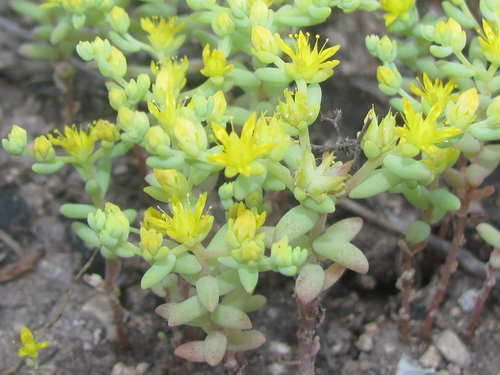


Yellow Stonecrop
sedum nuttallii
Yellow Stonecrop (Sedum nuttallii, also classified as Sedum nuttallianum) is a charming, low-growing annual succulent native to the rocky glades and barren plains of the south-central United States. Thriving where few other plants can survive, it hugs shallow soils on sandstone, granite, or limestone outcrops. During the spring, these resilient plants transform harsh rocky landscapes into vibrant carpets of golden yellow. As a succulent, it is highly adapted to drought, storing water in its fleshy, plump leaves to endure dry spells. This hardy pioneer species plays a vital ecological role by stabilizing thin soils and providing early-season nectar for a variety of native pollinators.
Lebensraum: Found on rocky glades, sandstone outcrops, granite flatrocks, and thin, barren soils across the south-central United States.
This delicate annual herb typically reaches heights of 5 to 15 cm, forming small, branched tufts. Its fleshy, succulent leaves are alternate, cylindrical to somewhat flattened, and often turn a vibrant reddish-bronze when exposed to intense sunlight or drought stress. In late spring, it produces clusters of small, star-like yellow flowers, each featuring four to five bright yellow petals, matching yellow stamens, and pointed green sepals.
Kategorie
PflanzenSeltenheit
Common
Gefahr
1/5 · Sehr gering
Snaps
Mach den ersten Snap!
Despite growing in extremely thin soils that dry out completely, its CAM photosynthesis allows it to seal its breathing pores during the blistering day.
It is an annual plant, meaning it completes its entire life cycle from seed germination to flowering and seed release within a single year.
Its leaves act as miniature water reservoirs, swelling up during rains and turning a brilliant crimson during dry spells to protect against sunburn.
Utilizes Crassulacean Acid Metabolism, allowing it to capture carbon dioxide at night and keep its pores closed during the hot, dry day to prevent water loss.
Produces red anthocyanin pigments under high-light or drought stress, shielding its delicate inner tissues from intense sun damage.
Completes its entire lifecycle within a few months of spring, setting hardy seeds that lie dormant to survive harsh summer droughts.
As an autotrophic plant, it generates its own energy through photosynthesis, utilizing sunlight, carbon dioxide, and water while absorbing key minerals from sparse, rocky soils.
Habropoda laboriosa
Provides critical spring nectar and pollen to native bees visiting rocky glades.
Euptoieta claudia
Its succulent leaves are occasionally consumed by generalist insect herbivores.
Für dieses Objekt sind noch keine Merkmal-Badges vergeben.
Noch keine Alternativnamen vorhanden.
Sammlungen für dieses Objekt erscheinen hier, wenn weitere Themen hinzugefügt werden.
Gefahr
1/5 · Sehr gering
Noch keine besonderen Sicherheitshinweise.
Der einfachste Weg, Yellow Stonecrop zu bestimmen, ist die Verwendung der Naturführer-App Snappit.
5+ cm
0.001+ kg
As an autotrophic plant, it generates its own energy through photosynthesis, utilizing sunlight, carbon dioxide, and water while absorbing key minerals from sparse, rocky soils.
Found on rocky glades, sandstone outcrops, granite flatrocks, and thin, barren soils across the south-central United States.
Foraging
Zoome hinein, um Cluster aufzulösen und zu sehen, wo dieses Objekt fotografiert wurde.
Neueste Snaps erscheinen hier, wenn neue Beobachtungen hinzukommen.

Arkansas, US
Hier kann man sehen Widow's-Cross, Yucca Giant-Skipper und Outis Skipper.
Führer anzeigen →

Oklahoma, US
Hier kann man sehen Lace Hedgehog Cactus und Star Cloak Fern.
Führer anzeigen →










