
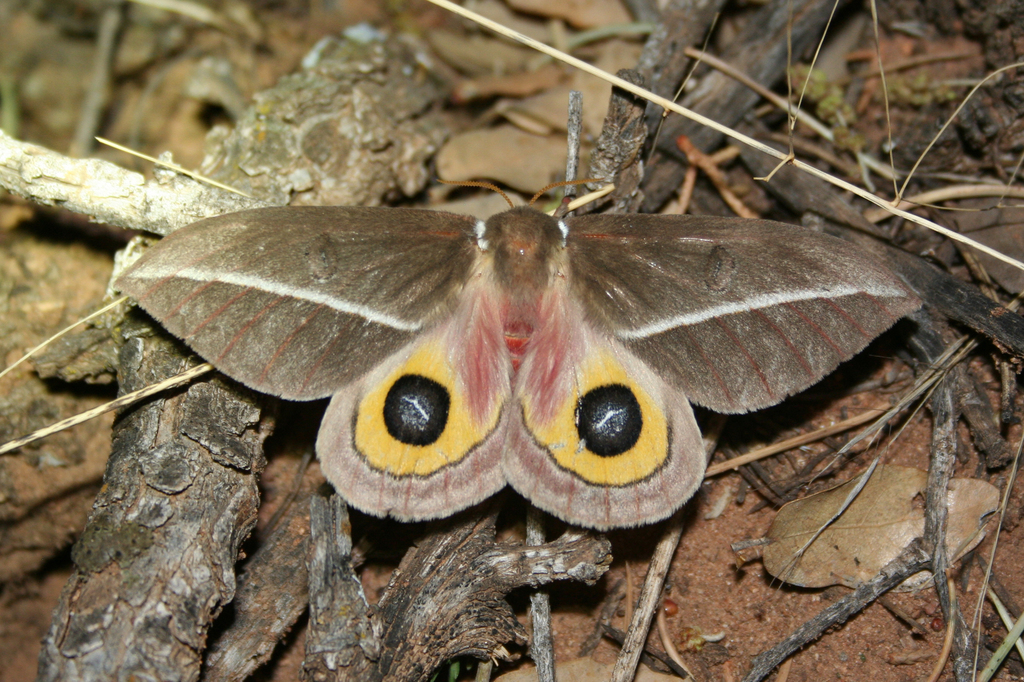





Zephyr Eyed Silkmoth
Automeris zephyria
The Zephyr Eyed Silkmoth is a beautiful moth with big, colorful eyes on its wings. These eyes help scare away predators! They are mostly active at night and love to flutter around gardens.
Lebensraum: Forests
The Zephyr Eyed Silkmoth has broad wings, typically yellowish to reddish-brown, often with faint lines. Its most striking feature is the pair of large, vivid eyespots on its hindwings, which are black with a blue or white center and often rimmed with red. Its body is robust and covered in dense, soft hairs.
Kategorie
InsektenSeltenheit
Common
Gefahr
1/5 · Sehr gering
Snaps
Mach den ersten Snap!
Adult silkmoths live for only a few days; their main goal is to find a mate!
Before becoming a moth, its caterpillar spins a strong, silk cocoon for protection!
It belongs to the 'Giant Silkmoth' family, known for making huge, beautiful cocoons!
Its caterpillars are often brightly colored with spines, warning predators not to touch them!
Zephyr Eyed Silkmoth can flash its hindwings to reveal large, fake eyes because this sudden display can startle predators away.
Zephyr Eyed Silkmoth has forewings that blend with tree bark, helping them hide perfectly during the day.
Zephyr Eyed Silkmoth can fly at night, guided by moonlight and scents, to find mates and avoid daytime predators.
Adult moths do not eat; caterpillars munch on tree and shrub leaves.
Altersunterschiede: Adult moths do not feed, relying on energy stored from their caterpillar stage. Caterpillars are voracious leaf-eaters.
Bubo virginianus
Nocturnal owl preys on adult moths.
Archytas analis
Lays eggs on caterpillars, which are then eaten from inside.

Quercus virginiana
Caterpillars feed on its leaves for growth.
Salix nigra
Caterpillars feed on its leaves for growth.
Pelzig beschreibt Tiere, die eine dichte Schicht aus weichen Haaren oder Fell besitzen.
Einzelgänger leben den größten Teil ihres Lebens allein und interagieren mit Artgenossen nur zur Paarung oder zur Aufzucht der Jungen.
Beschreibt Pflanzen, die für eine Vielzahl von bestäubenden Organismen besonders attraktiv und nützlich sind.
Farbenfroh beschreibt Organismen oder Objekte, die eine große Vielfalt an leuchtenden und deutlich erkennbaren Farben aufweisen.

Dieses Merkmal kennzeichnet Lebewesen, deren Ernährung vollständig oder hauptsächlich aus pflanzlichem Material besteht.

Waldlebensräume sind terrestrische Lebensräume, die von dichtem Baumbestand dominiert werden und eine große Vielfalt an Pflanzen- und Tierarten beherbergen.

Nachtaktive Tiere sind hauptsächlich in den Nachtstunden aktiv und ruhen oder schlafen normalerweise tagsüber.

Beschreibt Organismen, die Pollen übertragen und so die Befruchtung und Fortpflanzung von Pflanzen ermöglichen.
Noch keine Alternativnamen vorhanden.
Gefahr
1/5 · Sehr gering
Always watch moths from a distance and don't try to catch them.
50-100 mm
25-45 mm
5-14 Tage
15 km/h
Adult moths do not eat; caterpillars munch on tree and shrub leaves.
Forests
6
Zoome hinein, um Cluster aufzulösen und zu sehen, wo dieses Objekt fotografiert wurde.
Neueste Snaps erscheinen hier, wenn neue Beobachtungen hinzukommen.




.jpg&width=800)







