

African Blue Tit
cyanistes teneriffae
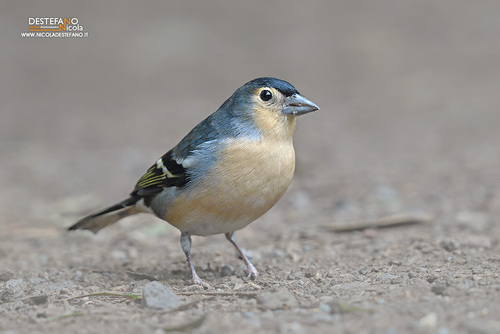
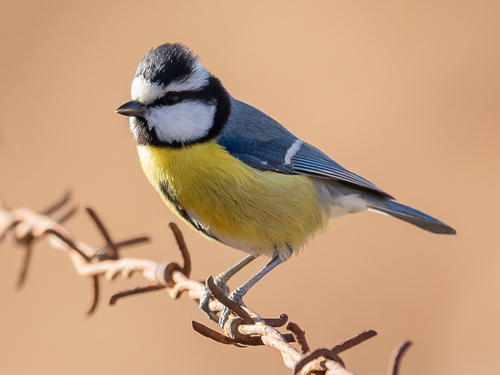
The African Blue Tit (Cyanistes teneriffae) is a charismatic and lively little passerine native to North Africa and the Canary Islands. Historically classified alongside its European cousin, the Eurasian Blue Tit, this species is distinguished by its strikingly dark ultramarine cap, deep cobalt blue upperparts, and vivid yellow underparts. Highly active and social, these birds are a delight to watch as they flit restlessly through the canopy, often performing acrobatic loops and hanging upside down to glean insects from foliage. Their presence is easily marked by their high-pitched, metallic trills and scolding calls. Over millions of years, the isolated environments of the Canary Islands have led to the divergence of several distinct subspecies, each uniquely adapted to its specific island home. This evolutionary divergence makes them highly prized by ornithologists studying island biogeography and speciation.
Hábitat: Typically found in Canary Island pine forests, laurel woodlands, oak forests, palm groves, and well-vegetated urban gardens.
The African Blue Tit is a diminutive bird measuring roughly 11 to 12 cm in length, with a wingspan of 15 to 18 cm. It features a brilliant yellow belly and breast, split by a faint dark line down the center. Its most striking identifier is its deeply saturated, dark ultramarine-blue crown, back, and wings, which appear much darker than those of the Eurasian Blue Tit. A white stripe wraps around its crown, contrasting sharply with a black eye-stripe and white cheeks. The legs are bluish-grey, and the short, stout beak is perfectly adapted for foraging.
Categoría
AvesRareza
Common
Peligro
1/5 · Muy bajo
Snaps
¡Sé la primera persona en hacer un snap!
On some dry islands, these resourceful birds have been observed sipping sweet nectar from local flowers, acting as minor pollinators.
They were long considered a subspecies of the Eurasian Blue Tit, but genetic analysis proved they diverged millions of years ago.
Unlike mainland tits that lay up to 12 eggs, Canary Island populations lay smaller clutches of 3 to 6 eggs to match resource availability.
Capable of foraging upside down on the thin outer twigs of trees to reach hidden insects and pine seeds.
Has developed distinct bill shapes across various Canary Islands to match the specific size and structure of local flora.
Employs a wide array of high-pitched whistles and alarm calls tailored to warn of aerial versus terrestrial predators.
Principally feeds on insects, spiders, and larvae during the breeding season, shifting to seeds, fruits, and nectar during the winter months.
Diferencias por edad: Chicks are fed an exclusive diet of soft caterpillars rich in proteins, whereas adults consume a mixed diet of insects, seeds, and seasonal nectar.
Accipiter nisus
The Eurasian Sparrowhawk is a primary avian predator that hunts adult African Blue Tits in forest environments.
Thaumetopoea pityocampa
The African Blue Tit feeds heavily on the highly destructive larvae of the Pine Processionary Moth, helping control its population.
Pinus canariensis
Forages for seeds and insects within the endemic Canary Island Pine, which provides vital nesting cavities and shelter.
Aún no hay insignias de rasgos asignadas a este objeto.
Todavía no hay alias listados.
Las colecciones para este objeto aparecerán aquí a medida que se añadan más temas.
Peligro
1/5 · Muy bajo
Todavía no hay notas especiales de seguridad.
La forma más fácil de identificar a African Blue Tit es usar la aplicación de identificación de naturaleza Snappit.
11+ cm
15+ cm
0.009+ kg
1+ años
30 km/h
Principally feeds on insects, spiders, and larvae during the breeding season, shifting to seeds, fruits, and nectar during the winter months.
Typically found in Canary Island pine forests, laurel woodlands, oak forests, palm groves, and well-vegetated urban gardens.
Acércate para separar los grupos y explorar dónde se ha fotografiado este objeto.
Los snaps recientes aparecerán aquí a medida que se añadan nuevas observaciones.