.jpg&width=800)





Agile Frog
Rana dalmatina
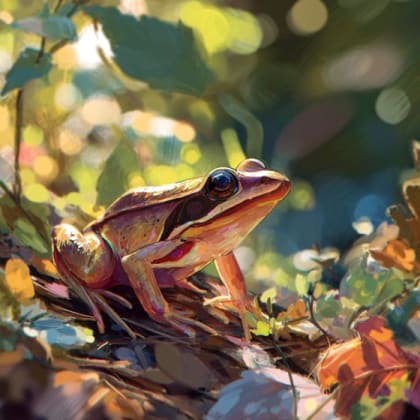
The Agile Frog is a small, lively frog that loves to hop around in wet places. It has a beautiful greenish-brown color that helps it blend in with nature.
Hábitat: Wetlands
The Agile Frog is a slender amphibian with long, powerful hind legs. It typically has smooth, light to reddish-brown skin with a distinct dark patch behind each eye, contrasting with its pale, unmarked belly. Its overall appearance is streamlined for jumping.
Categoría
AnfibiosRareza
Common
Peligro
1/5 · Muy bajo
Snaps
¡Sé la primera persona en hacer un snap!
Their Latin name Rana dalmatina refers to the Dalmatian coast where they were first described!
They can see tiny insects moving even in dim light, making them excellent night hunters!
Unlike many frogs, they often jump straight over obstacles instead of just going around them!
When startled, an Agile Frog can sometimes play dead for a moment to confuse a predator!
Agile Frog can leap incredible distances because of its long, powerful hind legs that help them escape predators and catch prey.
Agile Frog can stay underwater for long periods because its skin can absorb oxygen, helping them hide from dangers.
Agile Frog has varying skin colours that help them blend perfectly into their woodland and pond surroundings, making them hard to spot.
They are insect hunters, using their sticky tongue to snap up a variety of small invertebrates for a meal.
Diferencias por edad: Tadpoles are herbivorous, feeding on algae and plant matter, while adults are strictly carnivorous.
Natrix natrix
Grass snakes are common predators of adult Agile Frogs.
Lissotriton vulgaris
Smooth Newts hunt Agile Frog eggs and tadpoles.
.jpg&width=800)
Ardea cinerea
Grey Herons actively prey on frogs near water bodies.
Formica rufa
Agile Frogs frequently eat ants and other small insects.
Se caracteriza por tener los dedos conectados por una membrana, lo que generalmente ayuda a nadar.
Los animales cantores producen vocalizaciones complejas, a menudo con el propósito de atraer parejas, defender el territorio o comunicarse dentro de su especie.
El camuflaje describe a los organismos que poseen colores o patrones que les permiten mezclarse con su entorno.
Este rasgo identifica a los organismos cuya dieta consiste principalmente en insectos y otros pequeños invertebrados.

Este rasgo de hábitat identifica especies que se encuentran en humedales, que son áreas de tierra saturadas de agua, ya sea permanente o estacionalmente, e incluyen marismas, pantanos y ciénagas.

Los animales diurnos están activos principalmente durante el día y suelen descansar o dormir por la noche.

Este rasgo identifica a los organismos que exhiben una rapidez excepcional en sus movimientos para cazar, escapar o desplazarse.

Los hábitats acuáticos abarcan entornos donde los organismos viven principalmente en el agua, incluidos océanos, ríos, lagos y humedales.

El estado de peligro de extinción indica que una especie corre un riesgo muy alto de extinguirse en estado silvestre en un futuro próximo.
Todavía no hay alias listados.
Peligro
1/5 · Muy bajo
Always watch frogs from a distance and don't touch them, as they can be sensitive.
4.5-8 cm
0.005-0.025 kg
6-10 años
18 km/h
They are insect hunters, using their sticky tongue to snap up a variety of small invertebrates for a meal.
Wetlands
Ambush
450-1800
Acércate para separar los grupos y explorar dónde se ha fotografiado este objeto.
Los snaps recientes aparecerán aquí a medida que se añadan nuevas observaciones.