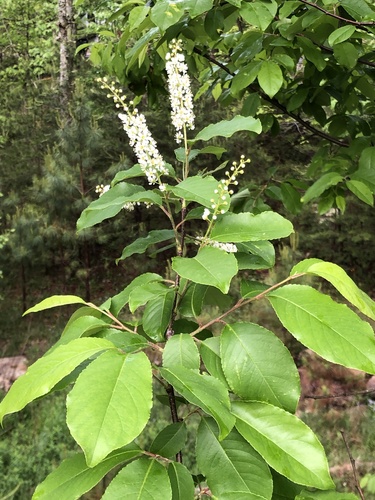


Alabama Cherry
prunus alabamensis
The Alabama Cherry (Prunus alabamensis) is a captivating deciduous tree, often appearing as a large shrub, native exclusively to a limited range within Alabama and Georgia. This species holds significant ecological value as an understory component of specific forest ecosystems. Distinguished by its early spring bloom of delicate white flowers and subsequent production of small, dark red cherries, it provides crucial early-season nectar and fruit resources for local wildlife. Despite its understated appearance, the Alabama Cherry is a testament to regional biodiversity, representing a unique evolutionary lineage adapted to the specific calcareous soils and dry, rocky woodlands it inhabits. Its rarity and restricted distribution underscore its importance as a species of conservation concern, making its identification and preservation vital for maintaining the health of its native habitats.
Hábitat: The Alabama Cherry is typically found in dry, rocky woodlands, often on calcareous soils, limestone outcrops, or sandy-loam soils within its specific geographic range.
The Alabama Cherry typically grows as a small tree or large shrub, reaching heights of 3 to 10 meters. Its bark is reddish-brown, often developing shallow furrows with age. Leaves are oval to elliptical, bright green, and finely toothed along the edges, turning yellow in autumn. In early spring, before or concurrent with leaf emergence, it produces clusters of small, fragrant white flowers, each with five petals. These flowers give way to small, pea-sized, dark red to purplish-black drupes (cherries) in late spring to early summer, which are edible but often tart.
Categoría
PlantasRareza
Common
Peligro
1/5 · Muy bajo
Snaps
¡Sé la primera persona en hacer un snap!
Despite being a cherry, it is not widely cultivated commercially but is valued by native plant enthusiasts for its hardiness and early spring blossoms.
Its scientific name, Prunus alabamensis, directly refers to the state where it was first discovered and primarily thrives.
The fruits of the Alabama Cherry, though tart, are edible and resemble small cultivated cherries, providing a snack for those familiar with its identification.
The species is an indicator of specific geological formations, often found growing on or near limestone bedrock which influences the soil's alkalinity.
This cherry species thrives in alkaline, calcium-rich soils, a specific environmental condition that many other Prunus species cannot tolerate, allowing it to occupy a unique niche.
Its early flowering period in spring provides a critical nectar source for pollinators when other food sources may be scarce, supporting early-emerging insect populations.
Adapted to dry, rocky woodland environments, Prunus alabamensis exhibits a degree of drought tolerance, enabling it to persist in conditions where water availability can be limited for significant periods.
As a plant, the Alabama Cherry produces its own food through photosynthesis, utilizing sunlight, carbon dioxide, and water, supplemented by mineral nutrients absorbed from the soil.
Apis mellifera
Pollinates flowers, gathering nectar and pollen.
Turdus migratorius
Consumes fruits, aiding in seed dispersal.
Odocoileus virginianus
Feeds on leaves and young shoots.
Glomeromycota
Forms symbiotic associations with roots for nutrient uptake.
Aún no hay insignias de rasgos asignadas a este objeto.
Todavía no hay alias listados.
Las colecciones para este objeto aparecerán aquí a medida que se añadan más temas.
Peligro
1/5 · Muy bajo
Todavía no hay notas especiales de seguridad.
La forma más fácil de identificar a Alabama Cherry es usar la aplicación de identificación de naturaleza Snappit.
300-1000 cm
20-50 años
As a plant, the Alabama Cherry produces its own food through photosynthesis, utilizing sunlight, carbon dioxide, and water, supplemented by mineral nutrients absorbed from the soil.
The Alabama Cherry is typically found in dry, rocky woodlands, often on calcareous soils, limestone outcrops, or sandy-loam soils within its specific geographic range.
Acércate para separar los grupos y explorar dónde se ha fotografiado este objeto.
Los snaps recientes aparecerán aquí a medida que se añadan nuevas observaciones.