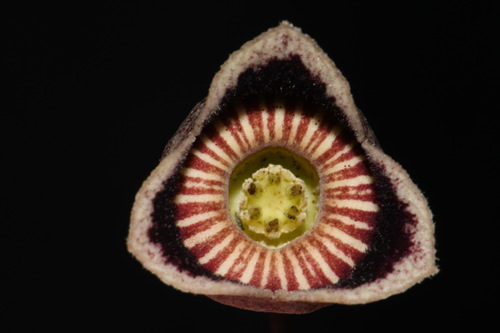


Alabama Heartleaf
asarum speciosum
The Alabama Heartleaf (Asarum speciosum) is a rare and distinctive perennial evergreen herb, endemic to specific regions of central Alabama. Belonging to the Aristolochiaceae family, commonly known as the birthworts, this plant is a hidden gem of the forest floor, captivating botanists and nature enthusiasts with its unique foliage and intriguing reproductive strategy. It thrives in rich, moist woodland environments, often indicative of high-quality, undisturbed habitats. Its presence is a strong biological indicator of a healthy forest ecosystem, making its conservation critically important. Unlike many showy wildflowers, the allure of the Alabama Heartleaf lies in its subtle beauty and specialized adaptations for survival in its unique niche.
Hábitat: The Alabama Heartleaf is found in rich, moist deciduous forests, often on limestone-derived soils of slopes, ravines, and stream banks, requiring filtered light to partial shade.
The Alabama Heartleaf is primarily identified by its striking evergreen foliage. Its leaves are cordate (heart-shaped) to reniform (kidney-shaped), dark green with prominent, often silvery-white or gray-green mottling that forms a beautiful variegated pattern. The leaves typically grow close to the ground, reaching 5-15 cm in width, and have a somewhat leathery texture. Its solitary, bell-shaped flowers are equally unique, appearing at ground level, often hidden beneath the leaves or leaf litter. These inconspicuous flowers are typically a deep maroon to reddish-brown, sometimes with lighter markings, and possess three distinct, somewhat fleshy lobes.
Categoría
PlantasRareza
Common
Peligro
1/5 · Muy bajo
Snaps
¡Sé la primera persona en hacer un snap!
Alabama Heartleaf is a member of the ginger family (Aristolochiaceae), though it is not used as a culinary spice like true ginger.
Its specific epithet 'speciosum' means 'showy' or 'beautiful,' referring to its striking variegated leaves despite its inconspicuous flowers.
The flowers are often called 'jug-flowers' or 'little brown jugs' due to their bell-like shape and color, which are typically found hidden at the base of the plant.
The genus name 'Asarum' comes from a Greek word meaning 'not to be harnessed,' possibly referring to its use in ancient medicine rather than as livestock feed.
The seeds of Asarum speciosum possess an elaiosome, a fatty appendage that attracts ants. Ants collect the seeds, carry them to their nests, consume the elaiosome, and then discard the viable seed, effectively dispersing it and aiding germination.
The variegated, mottled patterns on its evergreen leaves provide excellent camouflage against the dappled light and mixed detritus of the forest floor, helping it blend in and potentially deterring herbivores.
Its inconspicuous, bell-shaped flowers bloom at ground level, often hidden. This adaptation suggests pollination by small ground-dwelling insects like flies or gnats, attracted to their unique structure and subtle scent.
As a plant, the Alabama Heartleaf produces its own food through photosynthesis, converting sunlight, water, and carbon dioxide into sugars for energy and growth.
Formicidae species
Ants collect seeds with elaiosomes, aiding in seed dispersal.
Fungi species
Mycorrhizal fungi form a symbiotic relationship with the plant's roots, enhancing nutrient uptake.
Diptera species
Small insects, potentially flies or gnats, visit the ground-level flowers and assist in pollination.
Odocoileus virginianus
White-tailed deer may browse on the foliage, especially when other food sources are scarce.
Aún no hay insignias de rasgos asignadas a este objeto.
Todavía no hay alias listados.
Las colecciones para este objeto aparecerán aquí a medida que se añadan más temas.
Peligro
1/5 · Muy bajo
Todavía no hay notas especiales de seguridad.
La forma más fácil de identificar a Alabama Heartleaf es usar la aplicación de identificación de naturaleza Snappit.
5-15 cm
0.01-0.05 kg
5-15 años
As a plant, the Alabama Heartleaf produces its own food through photosynthesis, converting sunlight, water, and carbon dioxide into sugars for energy and growth.
The Alabama Heartleaf is found in rich, moist deciduous forests, often on limestone-derived soils of slopes, ravines, and stream banks, requiring filtered light to partial shade.
Acércate para separar los grupos y explorar dónde se ha fotografiado este objeto.
Los snaps recientes aparecerán aquí a medida que se añadan nuevas observaciones.




_-_Hypericum_%C3%97hidcoteense_-_flower.jpg&width=800)