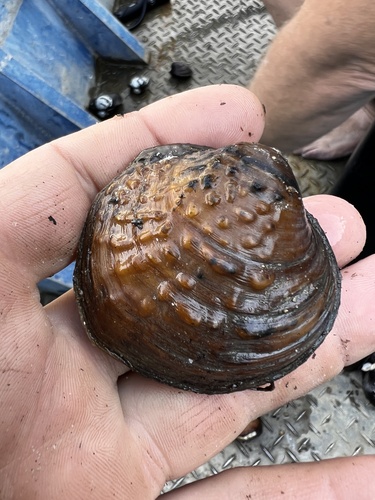


Alabama Orb
pustulosa kieneriana
The Alabama Orb (Pustulosa kieneriana) is a fascinating and ecologically vital species of freshwater mussel found primarily within the Mobile River basin in the southeastern United States. Belonging to the family Unionidae, this unassuming bivalve plays a monumental role in maintaining the health of its aquatic ecosystem. By continuously drawing in and expelling water, the Alabama Orb acts as a living biological filter, removing harmful particulate matter, algae, and excess nutrients from rivers and streams. This filtering process clarifies the water, benefiting a myriad of other aquatic organisms. Beyond their ecological utility, these mussels have an intricate and fascinating life cycle that relies heavily on local fish populations. The Alabama Orb represents the incredible, hidden biodiversity of North American freshwater systems, reminding us of the delicate balance that sustains underwater habitats.
Hábitat: Found partially buried in the sand or gravel substrates of clear, flowing freshwater rivers, streams, and shallow shoals.
The Alabama Orb is easily recognized by its robust, thick, and distinctly circular or spherical shell, which gives the species its common name. The outer shell, or periostracum, ranges in color from yellowish-brown in younger individuals to a darker chestnut or blackish-brown in mature adults. True to its genus name, the shell's surface is often adorned with scattered, small bumps or 'pustules' along the posterior ridge, though the extent of this texturing can vary. Inside the bivalve, the nacre (mother-of-pearl) is smooth and typically brilliant white or subtly iridescent, providing a stark contrast to the rough exterior. Adults generally measure between 3 and 6 centimeters in length, making them a moderately sized, easily concealed riverbed inhabitant.
Categoría
InvertebrateRareza
Common
Peligro
1/5 · Muy bajo
Snaps
¡Sé la primera persona en hacer un snap!
A single adult Alabama Orb can filter and clean up to a dozen gallons of river water in a single day.
Mussels like the Alabama Orb grow seasonal rings on their shells, similar to trees, which scientists use to determine their exact age.
Their microscopic larvae possess tiny, trap-jaw-like shells used to clamp onto fish gills without causing serious harm to the host.
Uses specialized internal gills to continuously pump and filter microscopic particles, actively purifying its surrounding aquatic environment.
Releases microscopic larvae called glochidia that temporarily clamp onto the gills of specific host fish to complete their development and disperse.
Employs a strong, fleshy appendage known as a foot to dig into gravelly substrates and anchor itself securely against turbulent river currents.
As a benthic filter feeder, it siphons a mixture of microscopic plant and animal matter from the water column.
Diferencias por edad: Larval glochidia absorb nutrients directly from the tissue of a host fish before maturing into free-living, filter-feeding adults.
Ictalurus punctatus
Acts as an essential temporary host for the mussel's parasitic glochidia larvae.
Ondatra zibethicus
Preys heavily on freshwater mussels by pulling them from the riverbed and cracking their shells.
Chlamydomonas reinhardtii
Consumed as a primary food source by the filter-feeding mussel.
Aún no hay insignias de rasgos asignadas a este objeto.
Todavía no hay alias listados.
Las colecciones para este objeto aparecerán aquí a medida que se añadan más temas.
Peligro
1/5 · Muy bajo
Todavía no hay notas especiales de seguridad.
La forma más fácil de identificar a Alabama Orb es usar la aplicación de identificación de naturaleza Snappit.
3-6 cm
0.02-0.08 kg
15-40 años
As a benthic filter feeder, it siphons a mixture of microscopic plant and animal matter from the water column.
Found partially buried in the sand or gravel substrates of clear, flowing freshwater rivers, streams, and shallow shoals.
Filtering
20000-80000
Acércate para separar los grupos y explorar dónde se ha fotografiado este objeto.
Los snaps recientes aparecerán aquí a medida que se añadan nuevas observaciones.

Alabama, US
Puedes ver Alabama Orb, Three-Horn Wartyback y Southern Pocketbook.
Ver guía →

Alabama, US
Puedes ver Musgo Español, Gecko Casero Del Mediterráneo y Anolis Verde.
Ver guía →

Alabama, US
Puedes ver Musgo Español, Hoja De Arce y Gecko Casero Del Mediterráneo.
Ver guía →












