

Almond
prunus amygdalus
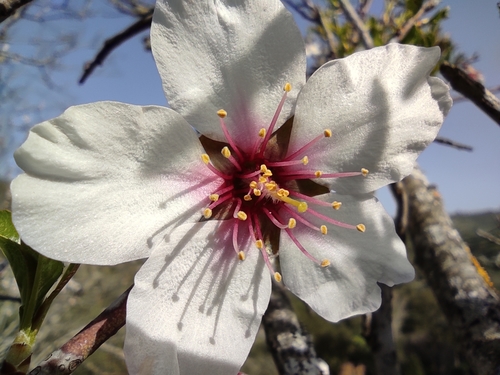
The almond (Prunus amygdalus) is a medium-sized deciduous tree native to the warm, arid climates of the Middle East and Western Asia, though it is now cultivated extensively around the globe. Belonging to the rose family, Rosaceae, this beautiful plant is highly celebrated for its spectacular early-season blossoms, which blanket orchards in delicate shades of pale pink and white before the green leaves even emerge. Culturally, historically, and economically vital, the almond is most famous for its nutrient-dense edible seed, which is technically a drupe kernel rather than a true botanical nut, encased in a tough woody shell and a green leathery hull.
Hábitat: Typically found in Mediterranean-style climates characterized by warm, dry summers and mild, wet winters, growing well in well-drained, deep soils on sunny hillsides and plains.
Typically growing between 4 and 10 meters in height, the almond tree features a trunk up to 30 centimeters in diameter with dark grey bark that develops deep fissures as it matures. Its leaves are lanceolate, finely serrated, and a vibrant green, measuring roughly 8 to 13 centimeters in length. In late winter or early spring, the tree showcases five-petaled flowers, appearing singly or in pairs, ranging in color from pure white to soft pink. The fruit is an oblong, green, velvety drupe that splits open at maturity to reveal the pitted, light brown woody shell inside.
Categoría
PlantasRareza
Common
Peligro
1/5 · Muy bajo
Snaps
¡Sé la primera persona en hacer un snap!
Almond pollination is the largest managed pollination event in the world, requiring more than one million beehives to be moved to California's Central Valley every February.
Botanically speaking, almonds are not true nuts; they are drupes, making them close genetic relatives to peaches, plums, and cherries.
Domestic sweet almonds owe their existence to a single genetic mutation that turned off the plant's ability to produce toxic cyanide precursors.
The tree develops an extensive and deep root system designed to access moisture reserves deep within the soil, allowing it to withstand long, hot summers with minimal water.
It flowers exceptionally early in the spring to take full advantage of early-season insect pollinators and complete its pollination cycle before other deciduous trees create shade.
Wild almond trees produce amygdalin, a chemical compound that breaks down into bitter, toxic hydrogen cyanide when crushed, successfully deterring most herbivores and pests.
As a photosynthetic producer, the almond tree manufactures its own sugars and energy using sunlight, carbon dioxide, and water, supplemented by inorganic nutrients absorbed from the soil.
Apis mellifera
Provides early-season nectar and pollen while relying entirely on them for fertilization and nut production.
Anarsia lineatella
The larvae of this moth tunnel into the green shoots and kernels, causing damage to the tree's vascular and reproductive structures.
Otospermophilus beecheyi
Regularly harvests and eats fallen or low-hanging mature almond drupes in orchard ecosystems.
Aún no hay insignias de rasgos asignadas a este objeto.
Todavía no hay alias listados.
Las colecciones para este objeto aparecerán aquí a medida que se añadan más temas.
Peligro
1/5 · Muy bajo
Todavía no hay notas especiales de seguridad.
La forma más fácil de identificar a Almond es usar la aplicación de identificación de naturaleza Snappit.
400+ cm
150+ kg
20+ años
As a photosynthetic producer, the almond tree manufactures its own sugars and energy using sunlight, carbon dioxide, and water, supplemented by inorganic nutrients absorbed from the soil.
Typically found in Mediterranean-style climates characterized by warm, dry summers and mild, wet winters, growing well in well-drained, deep soils on sunny hillsides and plains.
Acércate para separar los grupos y explorar dónde se ha fotografiado este objeto.
Los snaps recientes aparecerán aquí a medida que se añadan nuevas observaciones.