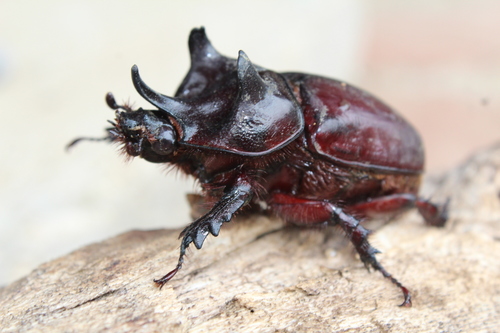


Aloeus Ox Beetle
strategus aloeus
The Aloeus Ox Beetle (Strategus aloeus) is a striking member of the rhinoceros beetle subfamily, renowned for its impressive size and the spectacular, trident-like horns borne by the males. Resembling miniature oxen or prehistoric beasts, these robust beetles are a fascinating sight on warm summer nights when they are most active. Males use their prominent thoracic horns in fierce, wrestling-style combat with rivals to win mating rights with females, which lack horns entirely. Despite their formidable, tank-like appearance, Aloeus Ox Beetles are completely harmless to humans. They are actually beneficial decomposers in their larval stage, helping to break down dead wood and return vital nutrients to the soil. Encountering one of these gentle giants humming through the night air or lumbering across a brightly lit porch is a thrilling experience for any nature enthusiast.
Hábitat: Typically found in sandy woodlands, oak scrub, mixed forests, and suburban areas where rotting stumps or root systems are available for their larvae.
The Aloeus Ox Beetle is a large, heavily armored insect measuring between 2.5 and 5.5 centimeters in length, with a glossy, dark reddish-brown to almost black exoskeleton. It exhibits extreme sexual dimorphism: major males possess three distinct, prominent horns projecting forward from their thorax, including a long central horn and two shorter, slightly curved lateral horns. Minor males have much shorter horns, while females completely lack them, featuring instead a heavily pitted, rounded thorax with a slight central depression. Both sexes have thick, spiky legs adapted for powerful digging and thick elytra (wing covers) that protect their delicate flying wings.
Categoría
InsectosRareza
Common
Peligro
1/5 · Muy bajo
Snaps
¡Sé la primera persona en hacer un snap!
Despite their heavy, armored bodies, Ox Beetles are capable flyers, although their flight sounds like a miniature, loudly humming helicopter.
Male Aloeus Ox Beetles exhibit incredible strength, capable of lifting objects many times their own body weight to flip rivals during mating battles.
The size of a male's horns is directly related to the nutrition he received while growing as a larva; poorly fed grubs become 'minor' males with very short horns.
When disturbed, these beetles can produce a loud, squeaking or hissing sound by rubbing their abdomen against their wing covers (stridulation) to startle predators.
Males use their three prominent horns as leverage tools to lift, flip, and throw rival males during intense battles over mating territories.
Equipped with heavily spined, robust forelegs, they are exceptional diggers capable of rapidly burrowing into hard soil and decaying wood.
Their thick, highly sclerotized chitinous shell provides excellent defense against biting predators and the impacts of aggressive male-on-male combat.
Larvae feed extensively on decaying roots, logs, and organic matter in the soil, while adults consume very little but may feed on overripe fruit, plant sap, or nectar.
Diferencias por edad: Larvae are voracious consumers of decaying wood and soil organics, whereas adults eat very little, surviving mostly on stored energy acquired during the larval stage to mate.
Dasypus novemcinctus
Nine-banded armadillos frequently dig up and consume the large, nutrient-rich larvae (grubs) of the ox beetle.
Quercus virginiana
Larvae depend on the decaying wood from various trees, especially oaks, to develop.
Megascops asio
Screech owls often prey on the large, slow-flying adult beetles at night.
Aún no hay insignias de rasgos asignadas a este objeto.
Todavía no hay alias listados.
Las colecciones para este objeto aparecerán aquí a medida que se añadan más temas.
Peligro
1/5 · Muy bajo
Todavía no hay notas especiales de seguridad.
La forma más fácil de identificar a Aloeus Ox Beetle es usar la aplicación de identificación de naturaleza Snappit.
2-5 cm
6-10 cm
0.003-0.008 kg
1-2 años
Larvae feed extensively on decaying roots, logs, and organic matter in the soil, while adults consume very little but may feed on overripe fruit, plant sap, or nectar.
Typically found in sandy woodlands, oak scrub, mixed forests, and suburban areas where rotting stumps or root systems are available for their larvae.
Foraging
Acércate para separar los grupos y explorar dónde se ha fotografiado este objeto.
Los snaps recientes aparecerán aquí a medida que se añadan nuevas observaciones.









.jpg&width=800)

