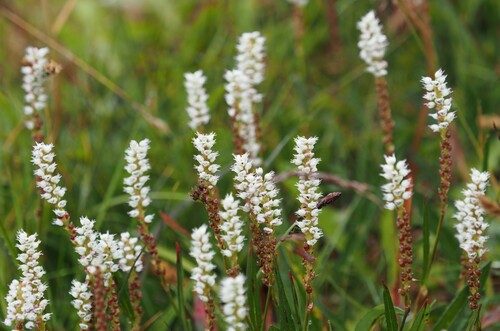


Alpine Bistort
bistorta vivipara
Alpine Bistort is a fascinating perennial herb that thrives in the cold, extreme environments of arctic and high-alpine regions. Unlike most plants that rely heavily on seeds for propagation, this resilient species has developed a remarkable reproductive strategy known as pseudovivipary. It produces tiny, bulb-like plantlets on its flowering stalk that are capable of dropping off and growing into new genetic clones. This clever adaptation bypasses the need for pollinators in short, unpredictable cold-climate growing seasons.
Hábitat: Found in alpine tundra, moist meadows, rocky slopes, and arctic heaths across high-altitude and high-latitude regions of the Northern Hemisphere.
This diminutive plant typically grows 5 to 30 centimeters tall, featuring a single, unbranched upright stem. Its leaves are narrow, lance-shaped, dark green on top, and somewhat pale beneath, with edges that slightly roll inward. The most striking identifier is the narrow, spike-like cluster at the top of the stem; the upper section displays small, five-petaled white to pale pink flowers, while the lower portion is densely packed with purplish-brown, bulb-like structures called bulbils.
Categoría
PlantasRareza
Common
Peligro
1/5 · Muy bajo
Snaps
¡Sé la primera persona en hacer un snap!
Because it clones itself using asexual bulbils, a single alpine meadow can host thousands of individual plants that are genetically identical.
The species name 'vivipara' translates to 'bringing forth alive,' describing how its bulbils can sprout tiny green leaves while still physically attached to the mother plant.
The starch-rich bulbils and rhizomes are edible, historically harvested by the Inuit and Sami peoples as a valuable, nutty-tasting survival food and source of vitamin C.
Produces pre-sprouted bulbils on its flower spikes that drop to the ground and grow into new plants, bypassing pollinator-dependence in freezing alpine conditions.
Utilizes a thick, twisted, underground rhizome packed with starch to survive extremely cold winter seasons and rapidly re-sprout in spring.
Partners with subterranean mycorrhizal fungi to enhance nutrient and phosphorus absorption from poor, nitrogen-deficient alpine soils.
As a photosynthetic plant, Alpine Bistort generates its own energy from sunlight, water, and carbon dioxide, drawing essential minerals through its root system.
Lagopus muta
The starch-rich bulbils are a critical high-energy food source for ptarmigans during the late alpine summer and freezing autumn months.
Urocitellus parryii
Its thick, underground rhizomes are actively excavated and consumed by ground squirrels preparing for hibernation.
Erebia epiphron
Provides nectar to various high-altitude insect species, including mountain ringlet butterflies.
Aún no hay insignias de rasgos asignadas a este objeto.
Todavía no hay alias listados.
Las colecciones para este objeto aparecerán aquí a medida que se añadan más temas.
Peligro
1/5 · Muy bajo
Todavía no hay notas especiales de seguridad.
La forma más fácil de identificar a Alpine Bistort es usar la aplicación de identificación de naturaleza Snappit.
5+ cm
0.005+ kg
5+ años
As a photosynthetic plant, Alpine Bistort generates its own energy from sunlight, water, and carbon dioxide, drawing essential minerals through its root system.
Found in alpine tundra, moist meadows, rocky slopes, and arctic heaths across high-altitude and high-latitude regions of the Northern Hemisphere.
Acércate para separar los grupos y explorar dónde se ha fotografiado este objeto.
Los snaps recientes aparecerán aquí a medida que se añadan nuevas observaciones.









.jpg&width=800)







