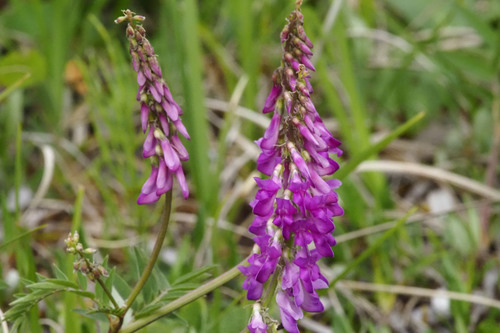


Alpine Sweet-Vetch
hedysarum alpinum
Alpine Sweet-Vetch (Hedysarum alpinum) is a resilient, perennial wildflower belonging to the legume family. Native to the subarctic and boreal regions of North America and Eurasia, this plant is celebrated for its beautiful sprays of pink-purple flowers and its vital role in high-latitude ecosystems. It is especially famous for its fleshy, edible taproots, which have historically sustained indigenous communities and wildlife alike through harsh northern winters. It thrives in gravelly river flats, alpine meadows, and open woodlands, bringing a burst of color to rugged northern landscapes.
Hábitat: Typically found on gravelly river flats, subalpine meadows, rocky slopes, and open boreal forests.
This herbaceous perennial typically grows to a height of 20 to 70 centimeters. It features erect, clumped stems adorned with pinnately compound leaves, each composed of 9 to 21 oblong, lance-shaped leaflets. In mid-to-late summer, it produces dense, one-sided racemes of drooping, pea-like flowers that range in color from pale pink to deep magenta. Following pollination, the flowers develop into distinctive, jointed seedpods called loments, which are flat, segmented, and contain individual seeds within each section.
Categoría
PlantasRareza
Common
Peligro
1/5 · Muy bajo
Snaps
¡Sé la primera persona en hacer un snap!
Historically, Indigenous peoples of Alaska and northern Canada harvested the sweet-tasting roots, eating them raw, boiled, or preserved in seal oil or lard.
It looks incredibly similar to the highly toxic 'Mackenzie's Sweet-Vetch' (Hedysarum mackenziei), making extremely careful identification crucial for wild foragers.
The plant became central to a modern survival mystery in Jon Krakauer's book 'Into the Wild', which hypothesized that adventurer Christopher McCandless died in Alaska after consuming toxic seeds of this plant, later proven to contain the toxic amino acid L-canavanine.
Houses symbiotic rhizobia bacteria in its root nodules to convert atmospheric nitrogen into usable nutrients, enriching poor subarctic soils.
Develops a thick, woody, and deeply penetrating taproot that helps it survive intense winds, soil erosion in gravel riverbeds, and severe winter freezes.
Produces segmented seedpods (loments) that easily break apart into individual units to be dispersed by wind, water, or passing animals.
As a photosynthetic plant, the Alpine Sweet-Vetch produces its own energy using sunlight, carbon dioxide, and water, supplemented by nitrogen fixed through a symbiotic relationship with soil bacteria.
Ursus arctos horribilis
Grizzly bears dig up and consume the sweet, nutritious roots of this plant, particularly in the spring and autumn when other food sources are scarce.
Glaucopsyche lygdamus
The larvae of this widespread butterfly feed on the foliage of Alpine Sweet-Vetch as a primary host plant.
Rhizobium leguminosarum
Rhizobium bacteria form a mutualistic relationship in the root nodules, fixing atmospheric nitrogen for the plant in exchange for carbohydrates.
Aún no hay insignias de rasgos asignadas a este objeto.
Todavía no hay alias listados.
Las colecciones para este objeto aparecerán aquí a medida que se añadan más temas.
Peligro
1/5 · Muy bajo
Todavía no hay notas especiales de seguridad.
La forma más fácil de identificar a Alpine Sweet-Vetch es usar la aplicación de identificación de naturaleza Snappit.
20-70 cm
0.05-0.3 kg
5-20 años
As a photosynthetic plant, the Alpine Sweet-Vetch produces its own energy using sunlight, carbon dioxide, and water, supplemented by nitrogen fixed through a symbiotic relationship with soil bacteria.
Typically found on gravelly river flats, subalpine meadows, rocky slopes, and open boreal forests.
Photosynthesis
Acércate para separar los grupos y explorar dónde se ha fotografiado este objeto.
Los snaps recientes aparecerán aquí a medida que se añadan nuevas observaciones.









.jpg&width=800)