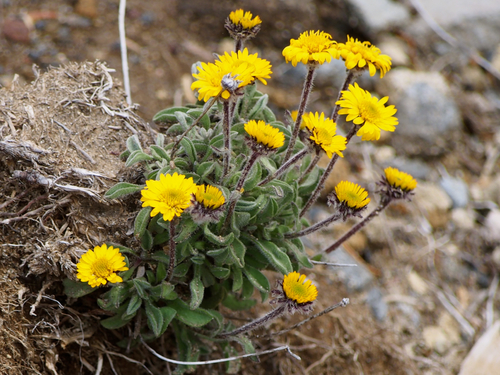


Alpine Yellow Fleabane
erigeron aureus
The Alpine Yellow Fleabane (Erigeron aureus) is a delightful, low-growing perennial herb that brings a splash of brilliant gold to the stark, windswept landscapes of northwestern North America's high mountain ranges. Thriving in alpine and subalpine zones, this resilient little plant clings to rocky crevices, talus slopes, and gravelly ridges where few other species can survive. It is celebrated by hikers and botanists alike for its cheerful, daisy-like appearance, which stands in stark contrast to the rugged alpine terrain. As a true high-altitude specialist, Erigeron aureus has evolved to withstand extreme cold, intense ultraviolet radiation, and drying winds, making it a rugged survivor of the peaks.
Hábitat: Found on rocky ridges, scree slopes, and alpine meadows at high elevations, typically near or above the treeline.
This species is easily recognized by its bright golden-yellow flower heads, which measure about 1.5 to 2.5 centimeters across. Unlike most other fleabanes, which have white or violet ray florets, the Alpine Yellow Fleabane features brilliant yellow petals surrounding a darker orange-yellow central disc. The plant is diminutive, reaching only 5 to 15 centimeters in height. Its spatula-shaped leaves are densely covered in fine, white, woolly hairs, giving the foliage a soft, greyish-green appearance.
Categoría
PlantasRareza
Common
Peligro
1/5 · Muy bajo
Snaps
¡Sé la primera persona en hacer un snap!
Despite its common name 'fleabane,' there is no scientific evidence that this plant can actually repel fleas.
It is one of the very few Erigeron species with bright yellow flowers, as most others are white, pink, or light violet.
The plant's deep taproot allows it to anchor firmly into shifting gravelly scree slopes and access deep water reserves.
Dense, fine white hairs coat the leaves and stems, acting as insulation against freezing alpine temperatures and reducing water loss from drying winds.
Forms a low-lying, ground-hugging rosette that minimizes exposure to wind and traps a micro-layer of warm air close to the soil.
Synthesizes specialized protective pigments and reflects intense high-altitude solar radiation using its reflective leaf hairs.
As a plant, it creates its own energy from sunlight, water, carbon dioxide, and essential nutrients absorbed from rocky alpine soils.
Bombus sylvicola
Pollinated by high-altitude bees seeking nectar during the brief summer flowering window.
Marmota caligata
Leaves and stems may be occasionally grazed by alpine rodents looking for green vegetation.
Aún no hay insignias de rasgos asignadas a este objeto.
Todavía no hay alias listados.
Las colecciones para este objeto aparecerán aquí a medida que se añadan más temas.
Peligro
1/5 · Muy bajo
Todavía no hay notas especiales de seguridad.
La forma más fácil de identificar a Alpine Yellow Fleabane es usar la aplicación de identificación de naturaleza Snappit.
5-15 cm
3-10 años
As a plant, it creates its own energy from sunlight, water, carbon dioxide, and essential nutrients absorbed from rocky alpine soils.
Found on rocky ridges, scree slopes, and alpine meadows at high elevations, typically near or above the treeline.
Foraging
Acércate para separar los grupos y explorar dónde se ha fotografiado este objeto.
Los snaps recientes aparecerán aquí a medida que se añadan nuevas observaciones.














