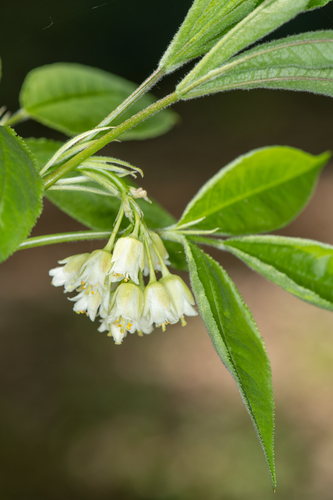


American Bladdernut
staphylea trifolia
The American Bladdernut is a charming deciduous shrub or small tree native to the moist woodlands and stream banks of eastern North America. Known for its elegant, drooping clusters of bell-shaped white flowers in late spring, it transitions to a truly distinctive feature in late summer: inflated, paper-like seed capsules that resemble miniature lanterns. These three-sided "bladders" rattle softly in the autumn breeze, giving the plant its whimsical common name. Growing as an understory plant, it plays a vital role in its woodland communities, offering shelter and resources for native wildlife. It is highly regarded by native plant enthusiasts for its structural interest, shade tolerance, and ornamental appeal throughout the changing seasons.
Hábitat: Typically found in moist, deciduous forests, rich alluvial soils, stream banks, and wooded slopes.
This plant typically grows as a multi-stemmed shrub or small tree reaching 1.5 to 6 meters in height. It features opposite, trifoliate leaves—divided into three finely-toothed leaflets—that turn a warm pale yellow in autumn. The bark is distinctive, featuring greenish-brown to gray coloration with white, vertical fissures. In spring, delicate white-to-greenish flowers dangle in pendulous clusters, succeeded by light-green, papery, air-filled capsules that mature to a tan or brown color and contain hard, shiny brown seeds.
Categoría
PlantasRareza
Common
Peligro
1/5 · Muy bajo
Snaps
¡Sé la primera persona en hacer un snap!
Historically, Native Americans and early settlers used the exceptionally hard, smooth seeds to make decorative beads and buttons.
Its scientific species name 'trifolia' refers directly to its compound leaves, which always grow in distinct groups of three.
The inflated seed pods can function as natural rattles, as the hard, glossy seeds loosen inside the dry bladder during autumn.
The paper-like, air-filled bladder capsule acts as a flotation device, allowing the seeds to disperse via streams and rivers during flood events.
Thrives under the heavy canopy of mature forests, optimizing low light levels to photosynthesize and grow efficiently where other plants struggle.
Readily produces root suckers to form dense thickets, helping to stabilize banks and recover quickly from physical damage.
As a photoautotrophic plant, the American Bladdernut produces its own organic nutrients using sunlight, carbon dioxide, water, and soil minerals.
Bombus impatiens
Bees visit the bell-shaped white flowers in late spring to gather nectar and pollen, acting as primary pollinators.
Odocoileus virginianus
Deer browse on the foliage and tender young twigs, especially during the spring and summer.
Tamias striatus
Small mammals collect and consume the hard, nut-like seeds that fall from the mature bladder pods.
Aún no hay insignias de rasgos asignadas a este objeto.
Todavía no hay alias listados.
Las colecciones para este objeto aparecerán aquí a medida que se añadan más temas.
Peligro
1/5 · Muy bajo
Todavía no hay notas especiales de seguridad.
La forma más fácil de identificar a American Bladdernut es usar la aplicación de identificación de naturaleza Snappit.
150-600 cm
20-50 años
As a photoautotrophic plant, the American Bladdernut produces its own organic nutrients using sunlight, carbon dioxide, water, and soil minerals.
Typically found in moist, deciduous forests, rich alluvial soils, stream banks, and wooded slopes.
1-4
Acércate para separar los grupos y explorar dónde se ha fotografiado este objeto.
Los snaps recientes aparecerán aquí a medida que se añadan nuevas observaciones.

Wisconsin, US
Puedes ver Cedro Rojo Oriental, Polipodio De Virginia y Buitre.
Ver guía →

Indiana, US
Puedes ver Tritón Oriental y Espuela De Caballero Enana.
Ver guía →

West Virginia, US
Puedes ver Campanillas De Virginia, Sanguinaria y Culantrillo Menor.
Ver guía →

Pennsylvania, US
Puedes ver Pluma De Salomón, Moonseed y Hoja De Agua De Virginia.
Ver guía →












.jpg&width=800)
