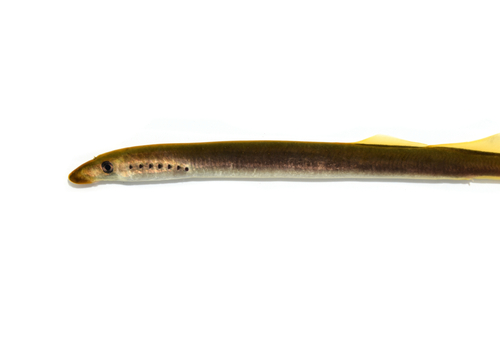


American Brook Lamprey
lethenteron appendix
The American Brook Lamprey is a fascinating, harmless member of the jawless fish lineage that thrives in clean, freshwater streams across eastern North America. Unlike some of its more notorious parasitic relatives, this gentle creature poses no threat to other fish. Instead, it plays a vital ecological role as an underwater gardener and clean-up crew during its extended larval stage. Spending up to seven years buried in sandy stream beds, it quietly filters nutrients from the water, contributing greatly to the health of its aquatic ecosystem. Once it undergoes metamorphosis into adulthood, the American Brook Lamprey undergoes a dramatic physical transformation. It emerges with functional eyes and a suction-like mouth, but remarkably, it ceases feeding altogether. Driven by a singular biological purpose, adults live for only a few weeks to spawn in shallow gravel nests before dying. This short, intense adult phase makes spotting them a rare and rewarding treat for keen-eyed stream explorers during the spring months.
Hábitat: Found in clear, cold streams and spring-fed brooks with sandy or gravelly substrates.
This small, eel-like fish typically ranges from 10 to 20 centimeters in length and is characterized by its jawless, circular mouth disk. Its body is smooth and scaleless, exhibiting a dark olive-brown to slate-gray coloration along the back that fades into a pale, yellowish-white belly. The American Brook Lamprey features a continuous dorsal fin with a distinct notched separation dividing it into two lobes, which helps distinguish it from other lamprey species. It possesses seven small, external gill openings lined up in a neat row behind each of its prominent eyes. Lacking paired fins, it swims with a characteristic serpentine, undulating wiggle close to the stream bottom.
Categoría
AnimalRareza
Common
Peligro
1/5 · Muy bajo
Snaps
¡Sé la primera persona en hacer un snap!
Adults lack a functional gut; after transforming from larvae, they live only to spawn and then die within a few weeks.
During spawning, multiple adults work together, using their suction mouths to lift and pile stones to construct communal nests.
Larvae, known as ammocoetes, are completely blind and toothless, spending up to seven years buried in muddy sediments.
Unlike their infamous parasitic relatives, American Brook Lampreys are completely non-parasitic and harmless to other fish.
As blind larvae, they can burrow deep into stream sediments and continuously filter out organic detritus, acting as natural purifiers.
Adults use their jawless, suction-cup mouth to clamp onto rocks, allowing them to remain stable in swift currents without expending swimming energy.
During transition to adulthood, they completely digest their own digestive tract, surviving and spawning purely on stored fat reserves.
Larval lampreys filter-feed on microscopic detritus and algae in mud, whereas adults do not eat at all, living off fat reserves.
Micropterus dolomieu
Adult lampreys and larvae are preyed upon during spawning season.
Navicula
Larval lampreys consume these microscopic organisms in muddy substrates.
Semotilus atromaculatus
Preys upon lamprey eggs in stream bed nests.
Aún no hay insignias de rasgos asignadas a este objeto.
Todavía no hay alias listados.
Las colecciones para este objeto aparecerán aquí a medida que se añadan más temas.
Peligro
1/5 · Muy bajo
Todavía no hay notas especiales de seguridad.
La forma más fácil de identificar a American Brook Lamprey es usar la aplicación de identificación de naturaleza Snappit.
10+ cm
0.005+ kg
5+ años
5 km/h
Larval lampreys filter-feed on microscopic detritus and algae in mud, whereas adults do not eat at all, living off fat reserves.
Found in clear, cold streams and spring-fed brooks with sandy or gravelly substrates.
Filtering
Acércate para separar los grupos y explorar dónde se ha fotografiado este objeto.
Los snaps recientes aparecerán aquí a medida que se añadan nuevas observaciones.




