

Angulose Prominent And Allies
peridea angulosa
The Angulose Prominent (Peridea angulosa) is a captivating member of the prominent moth family, Notodontidae, native to the deciduous forests of eastern North America. Named for the distinct, angular lines etched across its forewings, this nocturnal moth is an exceptional example of evolutionary camouflage. While the adults fly under the cover of darkness, their caterpillars are master illusionists, blending seamlessly into the foliage of their primary hosts, the oaks. Like many of its relatives, the adult Angulose Prominent does not feed, dedicating its brief adult life entirely to reproduction. This species and its close allies represent an essential link in forest ecosystems, serving as an abundant food source for insectivorous birds and bats while showcasing the intricate beauty of forest-dwelling Lepidoptera.
Hábitat: Typically found in mature deciduous and mixed woodlands, particularly where oak trees are abundant.
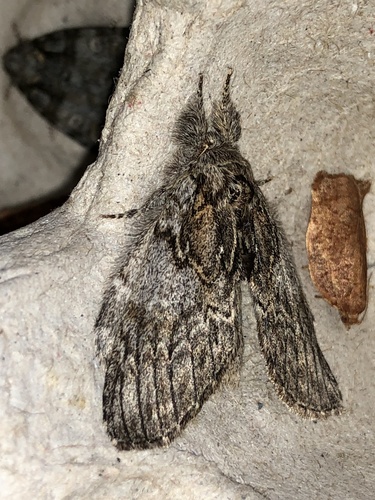
Adult Angulose Prominent moths have a wingspan ranging from 4 to 6 cm, featuring forewings with a complex pattern of charcoal, ash-grey, and warm brown tones, highlighted by a characteristic jagged or 'angulose' dark line. A small, pale cream or yellowish spot often sits near the forewing's base. When at rest, they fold their wings roof-like over their backs, mimicking a broken piece of tree bark. The caterpillars are bright green with pale yellow or pinkish lateral stripes that mirror the veins of oak leaves, helping them vanish from predators' sight.
Categoría
InsectosRareza
Common
Peligro
1/5 · Muy bajo
Snaps
¡Sé la primera persona en hacer un snap!
Adult Angulose Prominents do not have a functional digestive system; they live for only a week or two, fueled entirely by the energy they stored as caterpillars.
Despite being relatively common, these moths are rarely seen during the day because their bark-like patterns provide nearly perfect camouflage on tree trunks.
When threatened, the caterpillars can arch their bodies in a dramatic, defensive posture to deter potential predators.
Adults possess highly detailed grey and brown wing patterns that perfectly mimic lichen-covered tree bark, rendering them nearly invisible when resting on tree trunks during the day.
The larvae feature pale yellow and pink diagonal stripes along their green bodies, which align with the veins of host oak leaves to foil the search images of foraging birds.
Lacking functional mouthparts, the adults rely entirely on fat reserves stored from their caterpillar stage, maximizing energy efficiency to focus solely on locating mates.
The larvae feed exclusively on the foliage of broadleaf trees, particularly oaks, while the adult moths do not feed at all.
Quercus rubra
The primary larval host plant where females lay eggs and caterpillars feed on leaves.
Baeolophus bicolor
Forages in the forest canopy and opportunistically preys upon the well-camouflaged caterpillars.
Eptesicus fuscus
Mainly preys on the adult moths during their nocturnal mating flights.
Aún no hay insignias de rasgos asignadas a este objeto.
Las colecciones para este objeto aparecerán aquí a medida que se añadan más temas.
Peligro
1/5 · Muy bajo
Todavía no hay notas especiales de seguridad.
La forma más fácil de identificar a Angulose Prominent And Allies es usar la aplicación de identificación de naturaleza Snappit.
2+ cm
4+ cm
0.0001+ kg
1+ años
The larvae feed exclusively on the foliage of broadleaf trees, particularly oaks, while the adult moths do not feed at all.
Typically found in mature deciduous and mixed woodlands, particularly where oak trees are abundant.
Grazing
Acércate para separar los grupos y explorar dónde se ha fotografiado este objeto.
Los snaps recientes aparecerán aquí a medida que se añadan nuevas observaciones.