

Arctic Skipper
carterocephalus mandan
The Arctic Skipper (Carterocephalus mandan) is a charming, small butterfly belonging to the skipper family, Hesperiidae. Despite its cold-sounding name, this species is not confined to the high Arctic; instead, it populates wet meadows, sunny forest clearings, and grassy streamsides across boreal North America. It is beloved by butterfly enthusiasts for its distinct, energetic flying style, characterized by quick, darting movements close to the ground. Unlike many other skippers that can be notoriously difficult to identify, the Arctic Skipper boasts a beautiful, highly recognizable golden-orange checkered pattern. It spends its larval stage feeding diligently on native forest grasses while hidden inside protective leaf tubes, eventually overwintering as a mature caterpillar to emerge as a dazzling adult in late spring.
Hábitat: Typically found in moist boreal forest openings, wet meadows, marshy borders, and along grassy woodland trails.
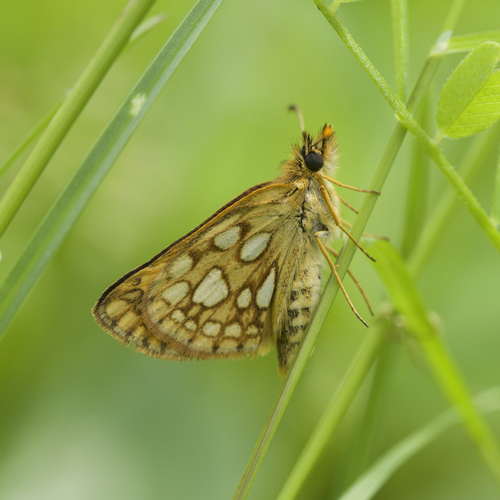
The Arctic Skipper is a small butterfly with a wingspan ranging from 2 to 3 centimeters. The upperside of its wings is dark brown to black, vividly patterned with a checkerboard of bright orange or yellow spots. On the underside, the hindwings are particularly striking, featuring a pale orange-yellow background adorned with several large, rounded, cream-to-silver spots outlined in dark borders. Its body is relatively stout and hairy, typical of skippers, and it holds its wings in a characteristic jet-plane posture when basking in the sun.
Categoría
InsectosRareza
Common
Peligro
1/5 · Muy bajo
Snaps
¡Sé la primera persona en hacer un snap!
Despite its name, the Arctic Skipper is not actually found in the true high Arctic tundra, but rather in temperate and boreal forest zones.
The caterpillar constructs a home by rolling a single blade of grass into a tube, coming out only to feed on adjacent blades.
Unlike many skippers that rest with their wings in a triangular shape, the Arctic Skipper often basks with its wings spread completely flat.
As caterpillars, they use silk to roll and bind grass leaves into tight tubes, creating protective micro-habitats to shield themselves from predators and harsh weather.
They spend the winter as fully grown caterpillars, surviving freezing sub-zero temperatures by entering a state of diapause where they can tolerate extreme cold.
They possess a rapid, bouncy, and highly unpredictable flight pattern close to the ground, which makes it exceptionally difficult for predators to track or capture them.
Caterpillars feed exclusively on various woodland grasses, while adult skippers drink sweet nectar from a wide range of spring wildflowers.
Calamagrostis purpurascens
Provides essential larval nourishment and serves as the primary host plant for caterpillars.
Fragaria virginiana
Serves as an important nectar source for the adult butterfly during its spring flight period.
Misumena vatia
Opportunistically preys on the adult butterfly as it rests on flowers to feed.
Aún no hay insignias de rasgos asignadas a este objeto.
Todavía no hay alias listados.
Las colecciones para este objeto aparecerán aquí a medida que se añadan más temas.
Peligro
1/5 · Muy bajo
Todavía no hay notas especiales de seguridad.
La forma más fácil de identificar a Arctic Skipper es usar la aplicación de identificación de naturaleza Snappit.
1+ cm
2+ cm
0.0001+ kg
1+ años
12 km/h
Caterpillars feed exclusively on various woodland grasses, while adult skippers drink sweet nectar from a wide range of spring wildflowers.
Typically found in moist boreal forest openings, wet meadows, marshy borders, and along grassy woodland trails.
Acércate para separar los grupos y explorar dónde se ha fotografiado este objeto.
Los snaps recientes aparecerán aquí a medida que se añadan nuevas observaciones.
















