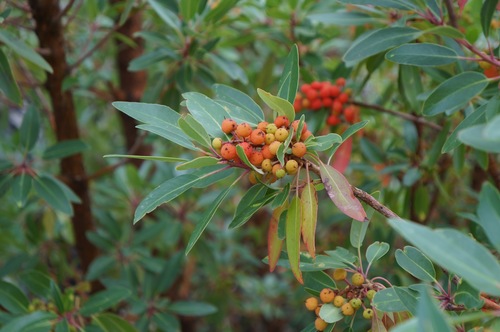


Arizona Madrone
arbutus arizonica
The Arizona Madrone (Arbutus arizonica) is an enchanting evergreen tree native to the canyons and dry mountain slopes of the southwestern United States and northern Mexico. Standing as a hallmark of the Madrean pine-oak woodlands, this resilient species is renowned for its striking peeling bark, glossy leaves, and delicate clusters of bell-shaped flowers. As a slow-growing tree, it brings long-lasting structure and vibrant year-round color to its rugged high-altitude ecosystem. In the wild, the Arizona Madrone plays a vital ecological role. Its sweet, fleshy berries provide critical sustenance for a wide array of woodland birds and mammals during the autumn and winter months, while its spring blooms attract numerous pollinators. This hardy tree has evolved remarkable strategies to withstand drought and wildfires, making it a rugged survivor of the arid mountain landscapes it calls home.
Hábitat: Typically found in oak-pine woodlands, canyons, and rocky mountain slopes at elevations between 1,200 and 2,400 meters.
This medium-sized tree typically reaches heights of 5 to 15 meters, characterized by an irregular, rounded crown. Its most distinctive visual feature is its smooth, reddish-brown bark, which exfoliates in thin, papery scales to reveal a striking, pale green or cream-colored trunk underneath, eventually becoming dark grey and furrowed at the base. The leathery, lanceolate leaves are a glossy dark green on top and pale underneath, measuring about 5 to 10 centimeters. In spring, it bears clusters of small, urn-shaped flowers that are white to pale pink, followed in autumn by spherical, orange-red berries with a cobblestone-textured skin.
Categoría
PlantasRareza
Common
Peligro
1/5 · Muy bajo
Snaps
¡Sé la primera persona en hacer un snap!
The dense, heavy wood of the Arizona Madrone was historically prized for making durable tool handles and high-quality charcoal.
The edible berries have a slightly sweet, mild flavor but a grainy texture, and were traditionally used by indigenous peoples of the region.
The smooth bark peels away in papery sheets, which helps the tree shed epiphytic plants, fungi, and insect pests.
The exfoliating bark peels off to reveal a green inner layer capable of performing photosynthesis, helping the tree generate energy even when water stress causes leaf loss.
Following wildfire damage, the tree can rapidly regenerate by sprouting new shoots directly from its underground basal burl.
Equipped with thick, waxy leaves and a deep, extensive root system, it minimizes moisture loss and survives prolonged arid periods.
As a photosynthetic plant, the Arizona Madrone produces its own energy using sunlight, water, and carbon dioxide, while drawing essential nutrients from the surrounding soil.
Trogon elegans
The berries of the tree are a primary seasonal food source for this colorful bird species.
Cynanthus latirostris
This bird species is a major pollinator of the tree's bell-shaped spring flowers.
Odocoileus virginianus couesi
This mammal browses on the foliage and young shoots of the tree, especially during the dry winter months.
Aún no hay insignias de rasgos asignadas a este objeto.
Todavía no hay alias listados.
Las colecciones para este objeto aparecerán aquí a medida que se añadan más temas.
Peligro
1/5 · Muy bajo
Todavía no hay notas especiales de seguridad.
La forma más fácil de identificar a Arizona Madrone es usar la aplicación de identificación de naturaleza Snappit.
500-1500 cm
50-150 años
As a photosynthetic plant, the Arizona Madrone produces its own energy using sunlight, water, and carbon dioxide, while drawing essential nutrients from the surrounding soil.
Typically found in oak-pine woodlands, canyons, and rocky mountain slopes at elevations between 1,200 and 2,400 meters.
Acércate para separar los grupos y explorar dónde se ha fotografiado este objeto.
Los snaps recientes aparecerán aquí a medida que se añadan nuevas observaciones.