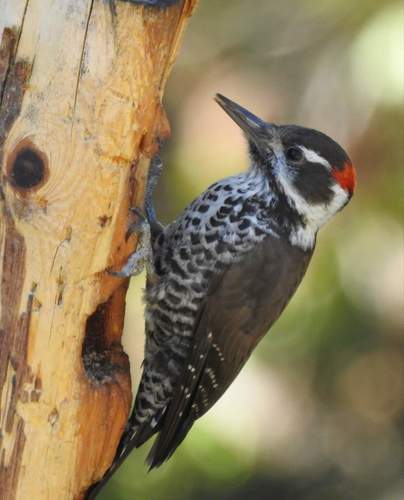


Arizona Woodpecker
leuconotopicus arizonae
The Arizona Woodpecker (Leuconotopicus arizonae) is a unique and quiet inhabitant of the oak-pine woodlands of the southwestern United States and western Mexico. Distinct from most other North American woodpeckers, it is characterized by its quiet foraging behavior and its unusual solid brown coloration. Rather than making loud, repetitive drumming sounds, it often works silently along the limbs of oaks and pines, quietly flaking away bark to find hidden insects. This bird's specialized habitat preferences and quiet nature make it a prized sight for birdwatchers exploring the canyons of the desert Southwest.
Hábitat: Found in montane oak-pine woodlands and riparian canyons, typically at elevations between 4,000 and 7,000 feet.
Measuring about 18 to 21 centimeters in length with a wingspan of roughly 35 to 38 centimeters, the Arizona Woodpecker is easily identified by its plain brown back and wings, contrasting sharply with a white, heavily brown-spotted breast. Its face is mostly white with a broad brown cheek patch and dark crown. Males feature a small but distinct red patch on the back of the head, which is entirely absent in females. Their bill is straight, chisellike, and greyish-black, matching their dark legs.
Categoría
AvesRareza
Common
Peligro
1/5 · Muy bajo
Snaps
¡Sé la primera persona en hacer un snap!
It is the only primarily brown-backed woodpecker species native to North America.
They form long-lasting monogamous pairs and often nest in cavities they excavate inside dead oak branches.
Unlike other woodpeckers that drum loudly to defend territory, the Arizona Woodpecker often relies on vocalizations and soft tapping.
Instead of drilling deep into wood, it uses its beak to pry and peel away flakes of bark to reveal hidden grubs.
Equipped with two toes pointing forward and two pointing backward, providing a strong grip for climbing vertical tree trunks.
Features a specialized spongy skull bone structure that cushions the brain from the impact of rapid pecking.
Feeds primarily on wood-boring beetle larvae, ants, and other insects, occasionally supplementing its diet with acorns and wild fruits.
Quercus arizonica
Uses the tree as its primary nesting site, foraging substrate, and source of acorns.
Agrilus auroguttatus
Actively hunts and consumes the larvae found beneath oak bark.
Accipiter cooperii
An avian predator that hunts adult and fledgling woodpeckers in the canopy.
Aún no hay insignias de rasgos asignadas a este objeto.
Todavía no hay alias listados.
Las colecciones para este objeto aparecerán aquí a medida que se añadan más temas.
Peligro
1/5 · Muy bajo
Todavía no hay notas especiales de seguridad.
La forma más fácil de identificar a Arizona Woodpecker es usar la aplicación de identificación de naturaleza Snappit.
18-21 cm
35-38 cm
0.034-0.051 kg
4-8 años
40 km/h
Feeds primarily on wood-boring beetle larvae, ants, and other insects, occasionally supplementing its diet with acorns and wild fruits.
Found in montane oak-pine woodlands and riparian canyons, typically at elevations between 4,000 and 7,000 feet.
Acércate para separar los grupos y explorar dónde se ha fotografiado este objeto.
Los snaps recientes aparecerán aquí a medida que se añadan nuevas observaciones.




.jpg&width=800)