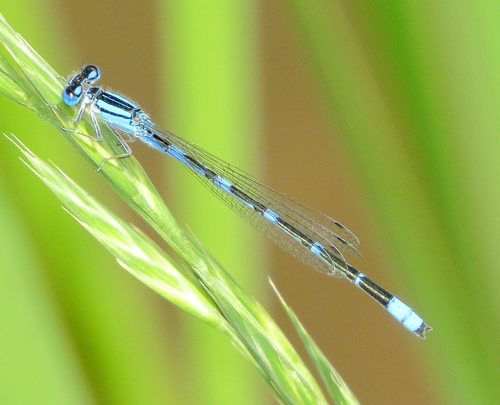


Arroyo Bluet
enallagma praevarum
The Arroyo Bluet (Enallagma praevarum) is an enchanting damselfly that brings a flash of brilliant blue to the arid and semi-arid waterways of western North America. Belonging to the family Coenagrionidae, these slender, delicate insects are frequently observed fluttering gracefully just above the water's surface or perched on low vegetation near streams and desert springs. Known for their active, low-altitude flights, Arroyo Bluets are key indicators of healthy freshwater ecosystems. Watching them hover and dart reveals a master of aerial maneuverability, as they patrol their small territories and seek out mates under the bright desert sun.
Hábitat: Typically found around slowly moving streams, desert arroyos, marshy ponds, and spring-fed wetlands in arid or semi-arid landscapes.
Adult male Arroyo Bluets are characterized by their vibrant sky-blue abdomen paired with intricate black rings and markings, culminating in a blue tip on the final segments. Their thorax features a distinctive blue-and-black striped pattern, and their eyes are a striking blue. Females exhibit a much more subdued coloration, often appearing in shades of tan, pale green, or dull blue with dark dorsal markings. They are small damselflies, measuring roughly 3 to 4 centimeters in length, with narrow, clear wings that they fold neatly along their backs when at rest.
Categoría
InsectosRareza
Common
Peligro
1/5 · Muy bajo
Snaps
¡Sé la primera persona en hacer un snap!
During mating, the pair forms a heart-like shape known as a 'mating wheel' while flying or resting on streamside vegetation.
Like other damselflies, Arroyo Bluets can rotate their heads almost 360 degrees to spot prey and predators in any direction.
Male Arroyo Bluets are highly territorial and will aggressively defend a choice patch of stream-side reeds from other males.
Capable of hovering in place, flying backward, and making sudden, rapid changes of direction to evade predators or capture tiny flying insects.
Males often remain attached to females in a tandem link while eggs are laid, guarding them against rival males and ensuring safe deposition into aquatic plants.
In their larval stage, they possess caudal gills that extract oxygen from water, allowing them to thrive in slow-moving, oxygen-depleted desert pools.
As both nymphs and adults, they are voracious predators of small invertebrates, playing a crucial role in controlling mosquito and gnat populations.
Diferencias por edad: Nymphs are aquatic generalists that ambush underwater invertebrates and tiny fish, whereas adults fly to pursue and capture aerial insects.
Culex quinquefasciatus
The Arroyo Bluet hunts this species in its larval form underwater and as flying adults near waterways.
Libellula saturata
Larger predatory dragonflies patrol the same streams and occasionally prey upon the smaller Arroyo Bluet.
Butorides virescens
This wading bird occasionally snatches adult damselflies resting on reeds or near the water surface.
Aún no hay insignias de rasgos asignadas a este objeto.
Todavía no hay alias listados.
Las colecciones para este objeto aparecerán aquí a medida que se añadan más temas.
Peligro
1/5 · Muy bajo
Todavía no hay notas especiales de seguridad.
La forma más fácil de identificar a Arroyo Bluet es usar la aplicación de identificación de naturaleza Snappit.
3+ cm
3+ cm
0.00005+ kg
1+ años
12 km/h
As both nymphs and adults, they are voracious predators of small invertebrates, playing a crucial role in controlling mosquito and gnat populations.
Typically found around slowly moving streams, desert arroyos, marshy ponds, and spring-fed wetlands in arid or semi-arid landscapes.
Acércate para separar los grupos y explorar dónde se ha fotografiado este objeto.
Los snaps recientes aparecerán aquí a medida que se añadan nuevas observaciones.
















