

Australian Blackthorn
bursaria spinosa
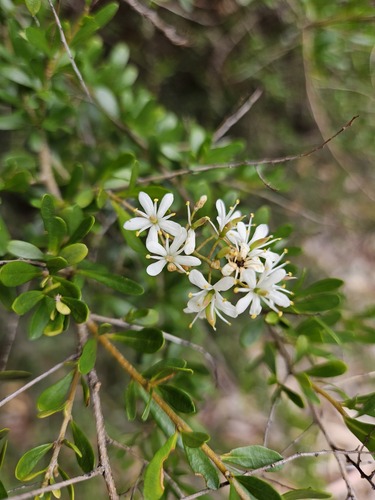
Australian Blackthorn (Bursaria spinosa) is a hardy, woody shrub or small tree native to eastern and southern Australia. Known for its thorny branches and sweet, jasmine-scented white flowers, this resilient plant plays a vital ecological role in dry sclerophyll forests and grassy woodlands. During mid-summer, it erupts in a sea of creamy-white blooms, earning it the alternative name 'Christmas Bush' in southern regions. This dramatic flowering event acts as an insect magnet, drawing in thousands of native bees, wasps, and butterflies. Beyond its beauty, the dense, prickly structure of Australian Blackthorn provides crucial protective nesting sites for small woodland birds, shielding them from larger predators. Its deep root system and ability to regenerate from a lignotuber make it exceptionally drought-tolerant and a key player in land reclamation and soil stabilization.
Hábitat: Found in a wide range of dry sclerophyll forests, open woodlands, coastal scrublands, and pastures across eastern and southern Australia.
This species typically grows as an erect, thorny shrub or small tree between 2 to 8 meters tall. It is characterized by small, wedge-shaped to obovate green leaves, up to 2.5 cm long, clustered along fine, rigid branches heavily armed with sharp thorns. In summer, it produces dense, terminal panicles of tiny, five-petaled white flowers that emit a sweet, honey-like fragrance. These flowers are succeeded by distinctive, flattened, heart-shaped or purse-like seed capsules that turn from green to a dry, papery brown when mature.
Categoría
PlantasRareza
Common
Peligro
1/5 · Muy bajo
Snaps
¡Sé la primera persona en hacer un snap!
During the colonial era, the sweet fragrance of its mid-summer blooms earned it the local moniker of 'Christmas Bush' in Tasmania and Victoria.
The genus name 'Bursaria' is derived from 'bursa', the Latin word for purse, which refers to the unique shape of its flat, heart-shaped seed pods.
The leaves of the Australian Blackthorn contain a substance called esculin, which was historically extracted and studied for its ability to absorb ultraviolet light.
Possesses a woody underground structure that allows the plant to vigorously resprout after intense bushfires or severe grazing.
Develops sharp, needle-like thorns along its branches to deter large herbivores from feeding on its foliage.
Produces esculin in its leaves, a natural chemical compound that helps absorb harmful ultraviolet radiation.
As a photosynthetic plant, it synthesizes its own food using sunlight, carbon dioxide, water, and soil minerals.
Paralucia pyrodiscus lucida
Hosts caterpillars of this endangered butterfly, which feed exclusively on its leaves.
Jalmenus evagoras
Caterpillars feed on the foliage of the blackthorn while being attended by mutualistic ants.
Apis mellifera
Feeds on the rich nectar produced by the summer blooms, aiding in cross-pollination.
Aún no hay insignias de rasgos asignadas a este objeto.
Todavía no hay alias listados.
Las colecciones para este objeto aparecerán aquí a medida que se añadan más temas.
Peligro
1/5 · Muy bajo
Todavía no hay notas especiales de seguridad.
La forma más fácil de identificar a Australian Blackthorn es usar la aplicación de identificación de naturaleza Snappit.
200-800 cm
20-60 años
As a photosynthetic plant, it synthesizes its own food using sunlight, carbon dioxide, water, and soil minerals.
Found in a wide range of dry sclerophyll forests, open woodlands, coastal scrublands, and pastures across eastern and southern Australia.
Acércate para separar los grupos y explorar dónde se ha fotografiado este objeto.
Los snaps recientes aparecerán aquí a medida que se añadan nuevas observaciones.