

Avalanche Lily
erythronium montanum
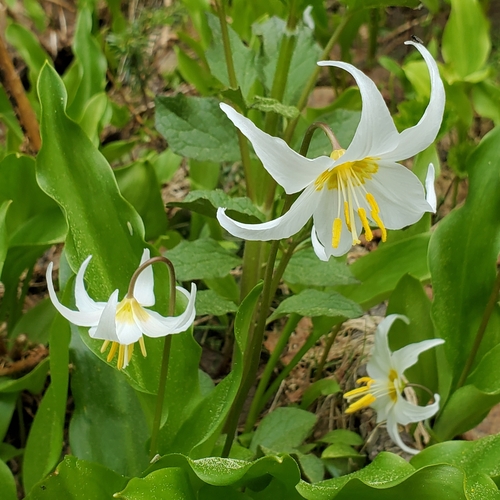
The Avalanche Lily (Erythronium montanum) is a breathtaking perennial wildflower native to the high-elevation meadows of northwestern North America. Famed for its ability to push through melting snowbanks in early summer, this resilient lily paints alpine slopes in brilliant sweeps of white and yellow. It serves as an iconic indicator of the changing seasons in subalpine zones, signaling the arrival of the brief montane summer. Beyond its sheer visual beauty, the Avalanche Lily plays a crucial ecological role in its fragile habitat. Its deep-seated bulbs provide essential early-season nourishment for foraging wildlife like grizzly bears and rodents, while its blooms attract native pollinators. Finding a meadow carpeted in these delicate flowers is an unforgettable experience for hikers and nature enthusiasts exploring the Pacific Northwest.
Hábitat: Found in moist subalpine meadows, open coniferous forests, and alpine tundra near the melting snowline of the Pacific Northwest mountains.
The Avalanche Lily features single or clustered nodding white flowers, each boasting six sharply recurved tepals that flare backward to reveal a bright yellow center. From the center of the blossom, prominent white to cream-colored stamens hang downward. Its slender, unbranched stems reach heights of 15 to 35 centimeters, arising from a pair of basal leaves. Unlike some of its relatives, the lance-shaped leaves of Erythronium montanum are a solid, rich green color without mottled markings, helping observers distinguish it from other fawn lilies.
Categoría
PlantasRareza
Common
Peligro
1/5 · Muy bajo
Snaps
¡Sé la primera persona en hacer un snap!
Indigenous peoples of the Pacific Northwest historically harvested the bulbs as a food source, steam-cooking or drying them for winter.
The seeds of the Avalanche Lily are dispersed by ants, a process known as myrmecochory, attracted by a fleshy appendage on the seed called an elaiosome.
They are one of the first wildflowers to bloom in high elevations, sometimes literally growing directly through thin sheets of ice.
Utilizes energy reserves to grow and push its shoots directly through thin layers of melting ice and snow in late spring.
Relies on a deeply buried, starch-rich bulb that protects the plant from freezing winter temperatures and stores energy for rapid spring emergence.
Partners with subterranean fungi to optimize nutrient absorption in nutrient-poor, rocky alpine soils.
As a photosynthetic plant, the Avalanche Lily produces its own food using sunlight, water, and carbon dioxide, aided by nutrients absorbed from the soil.
Bombus melanopygus
Pollinates the flowers while collecting nectar and pollen.
Ursus arctos
Digs up and consumes the starch-rich bulbs in early spring.
Odocoileus hemionus
Grazes on the tender green leaves and flowers.
Aún no hay insignias de rasgos asignadas a este objeto.
Todavía no hay alias listados.
Las colecciones para este objeto aparecerán aquí a medida que se añadan más temas.
Peligro
1/5 · Muy bajo
Todavía no hay notas especiales de seguridad.
La forma más fácil de identificar a Avalanche Lily es usar la aplicación de identificación de naturaleza Snappit.
10-40 cm
5-15 años
As a photosynthetic plant, the Avalanche Lily produces its own food using sunlight, water, and carbon dioxide, aided by nutrients absorbed from the soil.
Found in moist subalpine meadows, open coniferous forests, and alpine tundra near the melting snowline of the Pacific Northwest mountains.
Acércate para separar los grupos y explorar dónde se ha fotografiado este objeto.
Los snaps recientes aparecerán aquí a medida que se añadan nuevas observaciones.














.jpg&width=800)


