

Balearic Milk-Vetch
astragalus balearicus
The Balearic Milk-Vetch (Astragalus balearicus) is a fascinating, resilient shrub endemic to the wind-swept islands of Mallorca and Menorca. Growing in dense, hemispherical cushions, this plant is perfectly adapted to the harsh Mediterranean environment, where intense coastal winds, scorching summers, and poor limestone soils dominate. It is easily recognized by its dome-like structure and a protective lattice of sharp, woody spines. Beyond its architectural beauty, the Balearic Milk-Vetch plays an essential role in its native ecosystem. By acting as a nurse plant, its tight, protective hummocks shield delicate seedlings of other species from harsh weather and grazing animals, showcasing the incredible evolutionary adaptations of island flora under extreme environmental pressures.
Hábitat: Found on rocky limestone cliffs, coastal garrigue, and wind-exposed mountain scrublands of the Balearic Islands.
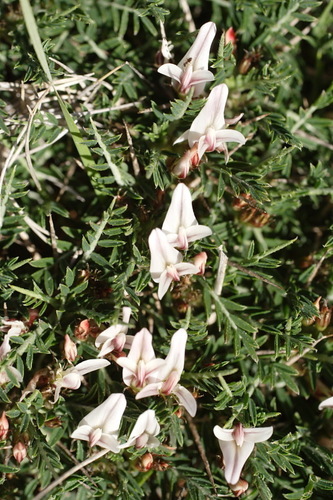
This species forms compact, extremely spiny, dome-shaped cushions ranging from 15 to 50 centimeters in height. Its leaves are pinnate with tiny, grayish-green leaflets that eventually fall away, leaving behind the leaf stems which harden into stiff, sharp, needle-like gray spines. During spring, it produces small, elegant, pea-like flowers that are typically white to pale cream, sometimes tinged with light violet or pink, emerging directly from the spiny canopy.
Categoría
PlantasRareza
Common
Peligro
1/5 · Muy bajo
Snaps
¡Sé la primera persona en hacer un snap!
It functions as a nurse plant, creating a protected, humid microclimate beneath its spiny dome that helps other fragile plant species survive.
Its scientific name 'astragalus' translates from Greek to 'anklebone,' historically referring to the shape of the seeds or roots of plants in this genus.
The plant's formidable spines are actually the leftover, hardened central petioles of its leaves from previous growing seasons.
The plant grows in a tight, aerodynamic dome that minimizes wind resistance and reduces water loss from evaporation in harsh climates.
Its sharp spines are modified leaf stalks that remain on the plant for years, forming a formidable defense against grazing herbivores.
It develops deep taproots that anchor into limestone crevices to access underground moisture during the arid Mediterranean summers.
As a photoautotrophic plant, it produces its own organic compounds using sunlight, carbon dioxide, and water via photosynthesis.
Apis mellifera
Visiting flowers for nectar and performing crucial pollination services during the spring blooming season.
Capra hircus
Exerts intense grazing pressure on the young shoots, although adult cushions are highly spiny and largely resistant.
Aún no hay insignias de rasgos asignadas a este objeto.
Todavía no hay alias listados.
Las colecciones para este objeto aparecerán aquí a medida que se añadan más temas.
Peligro
1/5 · Muy bajo
Todavía no hay notas especiales de seguridad.
La forma más fácil de identificar a Balearic Milk-Vetch es usar la aplicación de identificación de naturaleza Snappit.
15-50 cm
10-30 años
As a photoautotrophic plant, it produces its own organic compounds using sunlight, carbon dioxide, and water via photosynthesis.
Found on rocky limestone cliffs, coastal garrigue, and wind-exposed mountain scrublands of the Balearic Islands.
Acércate para separar los grupos y explorar dónde se ha fotografiado este objeto.
Los snaps recientes aparecerán aquí a medida que se añadan nuevas observaciones.