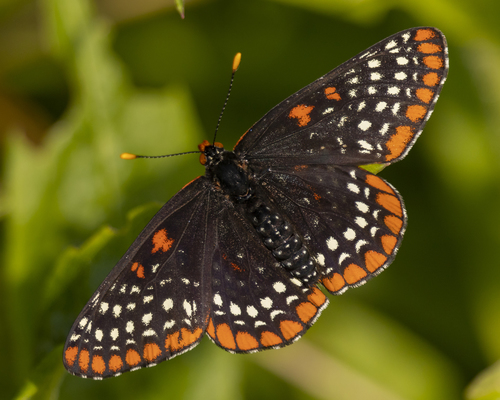


Baltimore Checkerspot
euphydryas phaeton
The Baltimore Checkerspot (Euphydryas phaeton) is a strikingly beautiful brush-footed butterfly and the proud state insect of Maryland. Named after George Calvert, the first Lord Baltimore, its vivid coloration perfectly matches the orange and black heraldry of his family crest. While adults are a fleeting mid-summer delight, their life cycle is intimately tied to specific wetland environments where their primary host plant thrives. Unfortunately, due to habitat loss, deer overgrazing, and changes in land management, these vibrant butterflies are becoming increasingly scarce in some parts of their historic range. Observing a colony of Baltimore Checkerspots fluttering gracefully among marsh vegetation is a highly rewarding experience for any nature enthusiast.
Hábitat: Found primarily in wet meadows, bogs, marshes, and streamsides where its main host plant, the white turtlehead, grows abundantly.
This medium-sized butterfly is easily identified by its predominantly black wings adorned with a striking marginal row of bright reddish-orange crescents. Inward from these orange borders are several rows of creamy-white or pale yellow spots, with additional reddish-orange spots located near the wing bases. The underside of the wings displays a similar, but more heavily patterned, checkerboard mosaic of orange, white, and black. Its wingspan typically ranges from 4.5 to 7 centimeters. As a caterpillar, it is equally distinct, featuring a dark, spiky body heavily banded with vibrant orange stripes.
Categoría
InsectosRareza
Common
Peligro
1/5 · Muy bajo
Snaps
¡Sé la primera persona en hacer un snap!
Before overwintering, the caterpillars construct a tough, silken tent near the ground where they sleep in a mass huddle until spring.
If a bird attempts to eat a Baltimore Checkerspot, it will likely spit it out immediately due to the bitter, toxic chemicals the butterfly absorbed as a caterpillar.
Its name honors George Calvert, the first Lord Baltimore, because the butterfly's black and orange colors perfectly match his family's heraldic shield.
The Baltimore Checkerspot is the official state insect of Maryland, designated in 1973.
Larvae consume iridoid glycosides from their host plants, storing these bitter compounds to make themselves and the adult butterflies toxic and unpalatable to predators.
Young caterpillars spin large, conspicuous silk webs on their host plants, providing a shared shelter where they feed and safely overwinter together.
The predominantly dark black coloration of their wings allows adult butterflies to efficiently absorb sunlight, rapidly warming their flight muscles on cool mornings.
Larvae are entirely folivorous, feeding on specific host plants, while adults consume nectar from various flowering wetland plants.
Diferencias por edad: Caterpillars chew on the leaves of host plants, whereas adults transition to using a proboscis to sip floral nectar.
Chelone glabra
Primary larval host plant where eggs are laid and early caterpillars feed.
Plantago lanceolata
Secondary host plant adopted by older caterpillars as they disperse to forage.
Asclepias syriaca
Major nectar source for adult butterflies during mid-summer flight periods.
Aún no hay insignias de rasgos asignadas a este objeto.
Todavía no hay alias listados.
Las colecciones para este objeto aparecerán aquí a medida que se añadan más temas.
Peligro
1/5 · Muy bajo
Todavía no hay notas especiales de seguridad.
La forma más fácil de identificar a Baltimore Checkerspot es usar la aplicación de identificación de naturaleza Snappit.
2-3 cm
4-7 cm
0.0001-0.0005 kg
1 años
12 km/h
Larvae are entirely folivorous, feeding on specific host plants, while adults consume nectar from various flowering wetland plants.
Found primarily in wet meadows, bogs, marshes, and streamsides where its main host plant, the white turtlehead, grows abundantly.
Acércate para separar los grupos y explorar dónde se ha fotografiado este objeto.
Los snaps recientes aparecerán aquí a medida que se añadan nuevas observaciones.

New York, US
Puedes ver Ciervo De Cola Blanca y Trillium Blanco Grande.
Ver guía →

Massachusetts, US
Puedes ver Abejorro Oriental Común, Tortuga Pintada y Rana Toro Americana.
Ver guía →

New York, US
Puedes ver Azulejo Oriental y Baltimore Checkerspot.
Ver guía →
















