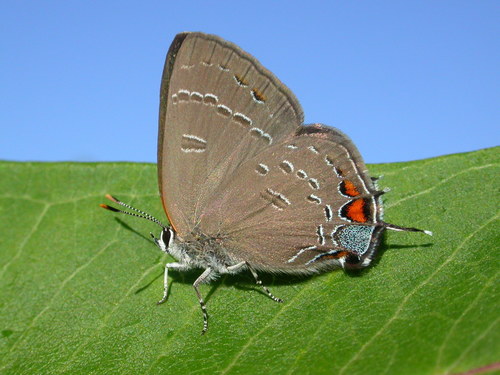


Banded Hairstreak
satyrium calanus
The Banded Hairstreak (Satyrium calanus) is a charming and common butterfly found across eastern North America, known for its intricate wing patterns and playful flight. As part of the 'hairstreak' family, it exhibits characteristic delicate tails on its hindwings, which are thought to aid in predator evasion. This species is a familiar sight in deciduous woodlands and open areas during the summer months, often seen nectaring on various wildflowers. Its life cycle showcases a complete metamorphosis, with the caterpillars feeding on the leaves of oak, hickory, and walnut trees, while the adults fuel themselves with nectar, playing a small but vital role in pollination.
Hábitat: Found primarily in deciduous woodlands, forest edges, clearings, old fields, and occasionally suburban gardens with ample host plants and nectar sources.
This small butterfly typically measures between 2.5 and 3.5 cm in wingspan. The upperside of its wings is a uniform grayish-brown. The underside of the hindwings features a distinctive white postmedian line, often bordered inwardly by a row of orange-red spots. Near the two delicate tails on each hindwing, there are usually several small, iridescent blue spots, which can sometimes be obscured. The forewings on the underside are similarly grayish-brown with a faint white line.
Categoría
InsectosRareza
Common
Peligro
1/5 · Muy bajo
Snaps
¡Sé la primera persona en hacer un snap!
Banded Hairstreaks lay their eggs singly on the twigs or buds of host trees, where they overwinter and hatch in the spring.
Despite their small size, these butterflies can be quite feisty, sometimes engaging in territorial disputes with other butterflies.
The 'hairstreak' name refers to the fine, hair-like tails found on the hindwings of many species in this butterfly group.
They are often seen 'dancing' or rubbing their hindwings together, which enhances the false head illusion to divert predators.
The delicate tails and eye-spots on the hindwings create a 'false head' illusion, leading predators to strike at the less vital hindwing area, allowing the butterfly to escape with minor damage.
When resting with wings closed, the underside coloration and patterns blend effectively with bark or dried leaves, making it difficult for predators to spot them.
Adults exhibit a rapid and somewhat erratic flight, which can make them challenging for avian predators to track and catch in mid-air.
As larvae, Banded Hairstreaks are herbivorous, feeding on tree leaves. Adults are nectarivorous, consuming nectar from various flowering plants.
Diferencias por edad: Larvae consume tree foliage, while adults primarily feed on flower nectar.
Quercus species
Primary larval food source
Carya species
Primary larval food source
Asclepias syriaca
Adult nectar source
Aves species
General predator
Aún no hay insignias de rasgos asignadas a este objeto.
Todavía no hay alias listados.
Las colecciones para este objeto aparecerán aquí a medida que se añadan más temas.
Peligro
1/5 · Muy bajo
Todavía no hay notas especiales de seguridad.
La forma más fácil de identificar a Banded Hairstreak es usar la aplicación de identificación de naturaleza Snappit.
0-1 cm
2-3 cm
0.0005-0.001 kg
0 años
As larvae, Banded Hairstreaks are herbivorous, feeding on tree leaves. Adults are nectarivorous, consuming nectar from various flowering plants.
Found primarily in deciduous woodlands, forest edges, clearings, old fields, and occasionally suburban gardens with ample host plants and nectar sources.
Foraging
Acércate para separar los grupos y explorar dónde se ha fotografiado este objeto.
Los snaps recientes aparecerán aquí a medida que se añadan nuevas observaciones.









.jpg&width=800)