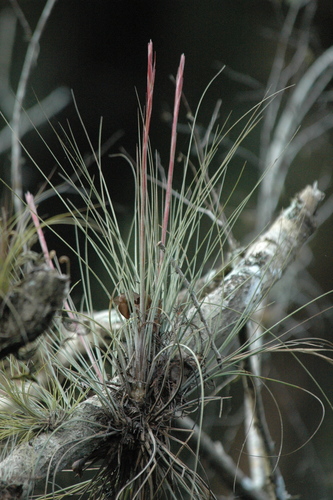


Bartram'S Airplant
tillandsia bartramii
Bartram's Airplant (Tillandsia bartramii) is a resilient, clump-forming epiphytic bromeliad native to the southeastern United States, Mexico, and parts of the Caribbean. Named in honor of the pioneering 18th-century American naturalist William Bartram, this plant grows perched on the trunks and branches of host trees, particularly Live Oaks and Bald Cypresses. Unlike parasitic plants, it does not harm its host; it uses its roots solely to anchor itself to the bark while absorbing all its moisture and essential nutrients from rainfall, dew, and dust through specialized leaf structures. This airplant is highly prized by nature enthusiasts for its delicate, spiky silhouette and its striking flowering display. During the blooming season, it produces a slender, colorful stalk that elevates bright violet flowers above its silvery-green foliage, adding a splash of tropical beauty to temperate woodland canopies. It plays an important role in its native ecosystem by providing microhabitats for small invertebrates and nectar for visiting pollinators.
Hábitat: Typically found growing high on the branches of mature broadleaf and coniferous trees in humid hammocks, swamps, and moist maritime forests.
This species forms dense, tufted clumps of slender, needle-like leaves that spread outwards and upwards, ranging from 15 to 40 centimeters in length. The foliage is grayish-green to silvery, owing to a dense covering of tiny, water-absorbing scales called trichomes. When flowering, Bartram's Airplant produces a single, erect, unbranched spike featuring rosy-pink to red bracts from which tubular, deep violet flowers emerge, each about 2 to 3 centimeters long.
Categoría
PlantasRareza
Common
Peligro
1/5 · Muy bajo
Snaps
¡Sé la primera persona en hacer un snap!
Its roots do not absorb water or nutrients; they function purely like organic glue to anchor the plant safely to tree bark high above the forest floor.
The tiny, dust-like seeds are equipped with silky, parachute-like hairs that allow them to float on the wind until they catch onto the rough bark of a suitable host tree.
This species is named after William Bartram, the pioneering American naturalist who documented the flora and fauna of the American South during the late 1700s.
Uses specialized leaf scales called trichomes to capture moisture, rainwater, and airborne nutrients directly from the surrounding air, bypassing the need for soil.
Possesses strong, wiry roots designed exclusively to clutch tree bark tightly, allowing the plant to withstand strong winds high in the canopy.
Utilizes Crassulacean Acid Metabolism, opening its stomata at night to absorb carbon dioxide and minimize water loss during the heat of the day.
As an autotrophic epiphyte, this plant manufactures its own energy via photosynthesis using sunlight, water, atmospheric carbon dioxide, and airborne minerals.
Quercus virginiana
Provides a physical anchor-point and microhabitat on its branches without extracting any nutrients from the tree.
Archilochus colubris
Visits the bright violet flowers to feed on nectar, acting as a primary pollinator.
Metamasius callizona
An invasive pest insect that feeds on the plant's inner tissue, often destroying the entire specimen.
Aún no hay insignias de rasgos asignadas a este objeto.
Todavía no hay alias listados.
Las colecciones para este objeto aparecerán aquí a medida que se añadan más temas.
Peligro
1/5 · Muy bajo
Todavía no hay notas especiales de seguridad.
La forma más fácil de identificar a Bartram'S Airplant es usar la aplicación de identificación de naturaleza Snappit.
15-40 cm
0.02-0.15 kg
5-15 años
As an autotrophic epiphyte, this plant manufactures its own energy via photosynthesis using sunlight, water, atmospheric carbon dioxide, and airborne minerals.
Typically found growing high on the branches of mature broadleaf and coniferous trees in humid hammocks, swamps, and moist maritime forests.
Acércate para separar los grupos y explorar dónde se ha fotografiado este objeto.
Los snaps recientes aparecerán aquí a medida que se añadan nuevas observaciones.












_-_geograph.org.uk_-_1314588.jpg&width=800)

