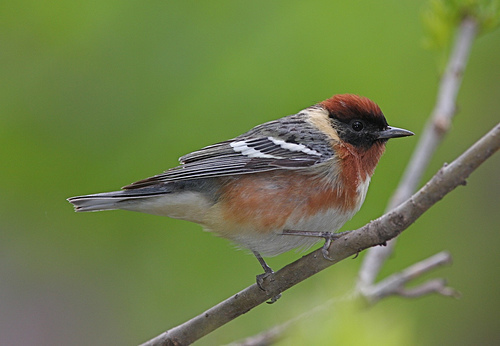


Bay-Breasted Warbler
setophaga castanea
The Bay-Breasted Warbler (Setophaga castanea) is a captivating songbird of the boreal forest, celebrated for its striking breeding plumage and its strong ecological association with spruce budworm outbreaks. Breeding across the dense coniferous forests of Canada and the northernmost United States, this migratory marvel travels thousands of miles each autumn to winter in southern Central America and northern South America. During the spring, males show off a rich, deep chestnut (bay) throat, breast, and sides, contrasted sharply with a cream-colored belly and a dark face. This species is a dynamic foraging specialist that plays a vital role in forest health by consuming massive quantities of forest pests, particularly caterpillars. Its population sizes are known to fluctuate dramatically in response to insect availability, booming during epidemic years of the spruce budworm. Observing a Bay-Breasted Warbler during migration is a highly sought-after prize for birdwatchers across eastern North America.
Hábitat: Found in mature coniferous forests, particularly spruce and fir stands, during the breeding season, and mid-elevation tropical forests during the winter.
During the breeding season, adult males are easily identified by their distinct rich chestnut-brown crown, throat, and flanks. They feature a black mask around the eyes, buffy-yellow patches on the sides of the neck, and a cream-colored lower breast and belly. Their backs are grayish with dark streaks, and they possess two prominent white wingbars. Females and non-breeding adults are much more subdued, showing olive-green upperparts, faint or absent chestnut wash on the flanks, and yellow-tinged breasts, making them a classic 'confusing fall warbler' challenge for birders.
Categoría
AvesRareza
Common
Peligro
1/5 · Muy bajo
Snaps
¡Sé la primera persona en hacer un snap!
Because they lose their bright colors and turn greenish-yellow in the autumn, they are famously classified by birdwatchers as one of the 'confusing fall warblers'.
During massive spruce budworm outbreaks, female Bay-Breasted Warblers can lay unusually large clutches of up to 7 eggs to capitalize on the abundant food supply.
On their wintering grounds in Panama and Colombia, they frequently join mixed-species foraging flocks and will readily feed on nectar and forest fruits.
This warbler exhibits a highly flexible breeding strategy, significantly increasing its clutch size and population density during spruce budworm outbreaks.
It is adapted to forage primarily in the dense interior of middle-to-high tree branches, utilizing rapid hopping and hovering to snatch insects from needles.
Uses geomagnetic cues and stellar navigation to migrate thousands of miles between northern boreal forests and South American wintering grounds.
Feeds heavily on insects and spiders, particularly spruce budworm caterpillars during the breeding season, supplemented with berries and nectar during migration and winter.
Choristoneura fumiferana
Primary food source during the breeding season; the warbler's population density increases significantly during caterpillar outbreaks.
Setophaga fusca
Competes for nesting sites and foraging space in the mid-to-high canopy of coniferous forests.
Accipiter striatus
A common aerial predator of small songbirds, frequently hunting migrating warblers in forest edges and canopies.
Aún no hay insignias de rasgos asignadas a este objeto.
Todavía no hay alias listados.
Las colecciones para este objeto aparecerán aquí a medida que se añadan más temas.
Peligro
1/5 · Muy bajo
Todavía no hay notas especiales de seguridad.
La forma más fácil de identificar a Bay-Breasted Warbler es usar la aplicación de identificación de naturaleza Snappit.
0.011+ kg
Feeds heavily on insects and spiders, particularly spruce budworm caterpillars during the breeding season, supplemented with berries and nectar during migration and winter.
Found in mature coniferous forests, particularly spruce and fir stands, during the breeding season, and mid-elevation tropical forests during the winter.
Foraging And Gleaning In Canopy", But In The Constraints "foraging", "gleaning" Is Better. Let's Use "foraging" As Standard Tag: "foraging" Or "pursuit" Or "ambush". Let's Use "foraging". Ensure It Matches The Schema Type String/null. Let's Use "foraging". Let's Review: "huntingmethod": "foraging". Wait, The Prompt Lists Options Like: Pursuit, Ambush, Foraging, Grazing, Filtering, Etc. So "foraging" Is Perfect. Let's Write "foraging". Let's Also Verify Dietchangeswithage: "nestlings Are Fed Exclusively Soft Bodied Insects And Spiders, Transitioning To A Wider Variety Of Insects, Berries, And Nectar As Adults.
Acércate para separar los grupos y explorar dónde se ha fotografiado este objeto.
Los snaps recientes aparecerán aquí a medida que se añadan nuevas observaciones.

Ohio, US
Puedes ver Reinita Protonotaria, águila Calva y Reinita Amarilla.
Ver guía →

Georgia, US
Puedes ver Bay-Breasted Warbler y Cascabel Diamantina Del Este.
Ver guía →

North Carolina, US
Puedes ver Bay-Breasted Warbler, Banderita De Halloween y Pumpkin Ash.
Ver guía →












