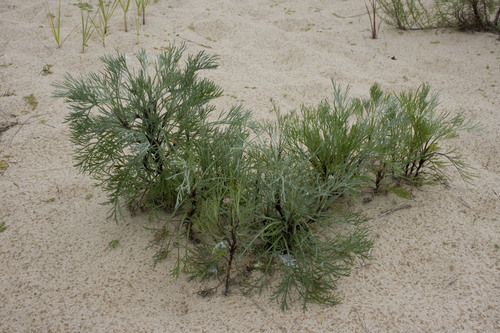


Beach Wormwood
artemisia caudata
Beach Wormwood, scientifically known as Artemisia caudata (often classified as a subspecies of Artemisia campestris), is a resilient and aromatic plant that thrives in some of North America's most challenging, nutrient-poor environments. Frequently found gracing sandy shores, sun-baked dunes, and dry prairies, this biennial or short-lived perennial is highly valued for its natural ability to stabilize shifting sands. When brushed or crushed, its foliage releases a distinctive, sharp scent characteristic of the sagebrush family. Though its tiny yellowish-green flowers might not immediately draw the human eye from afar, Beach Wormwood plays a crucial structural role in coastal and dryland ecosystems. By anchoring the soil with its deep roots, it creates a sheltered microhabitat that supports specialized dune-dwelling insects and delicate coastal flora, making it an unsung hero of shoreline conservation.
Hábitat: Primarily found in dry, sandy, open environments such as coastal beaches, sand dunes, sand prairies, and rocky barrens.
This upright herb typically features a basal rosette of highly dissected, deeply lobed, thread-like leaves that are grayish-green to silvery in appearance. In its second year of growth, it sends up a tall, branching, reddish or purplish stem that can reach up to 1.5 meters in height. From late summer into the fall, numerous inconspicuous, tiny yellowish-green to brownish flower heads bloom in elongated, branching clusters (panicles) along the upper stems. The plant generally has a fine, hairless, or slightly silky texture to the touch.
Categoría
PlantasRareza
Common
Peligro
1/5 · Muy bajo
Snaps
¡Sé la primera persona en hacer un snap!
Beach Wormwood typically has a biennial life cycle; it spends its first year as a low-lying rosette of leaves before shooting up a tall flowering stalk in its second year.
Despite being surrounded by massive bodies of fresh or salt water on beaches, it effectively lives in a 'desert' microclimate, as the pure sand drains water away almost instantly.
Its species name, 'caudata', translates to 'tailed' in Latin, referencing the long, narrow, tail-like clusters of its mature flower heads.
Native American tribes historically utilized various Artemisia species, including Beach Wormwood, for ceremonial smudging and traditional medicinal treatments for the skin.
Features deep taproots and narrow, thread-like leaves that minimize moisture loss, allowing it to thrive in extremely dry, sandy soils with low water retention.
Develops a robust and complex root system that binds loose coastal or desert sands together, actively preventing wind erosion.
Produces aromatic terpenes and essential oils in its foliage that create a bitter taste, effectively deterring most mammalian herbivores from grazing.
As a photosynthetic plant, Beach Wormwood produces its own energy using sunlight, drawing essential moisture and trace minerals from sandy soils.
Eupithecia absinthiata
Acts as a primary host plant for the caterpillars of specific moth species, providing necessary forage for their development.
Ammophila breviligulata
Shares sandy shoreline habitats, competing for limited moisture and space while collaboratively stabilizing the dune ecosystems.
Melanoplus differentialis
While mostly avoided by mammals due to its bitter chemical defenses, it is occasionally grazed by highly adaptable, generalist insects.
Aún no hay insignias de rasgos asignadas a este objeto.
Todavía no hay alias listados.
Las colecciones para este objeto aparecerán aquí a medida que se añadan más temas.
Peligro
1/5 · Muy bajo
Todavía no hay notas especiales de seguridad.
La forma más fácil de identificar a Beach Wormwood es usar la aplicación de identificación de naturaleza Snappit.
30-150 cm
2-5 años
As a photosynthetic plant, Beach Wormwood produces its own energy using sunlight, drawing essential moisture and trace minerals from sandy soils.
Primarily found in dry, sandy, open environments such as coastal beaches, sand dunes, sand prairies, and rocky barrens.
Acércate para separar los grupos y explorar dónde se ha fotografiado este objeto.
Los snaps recientes aparecerán aquí a medida que se añadan nuevas observaciones.


















