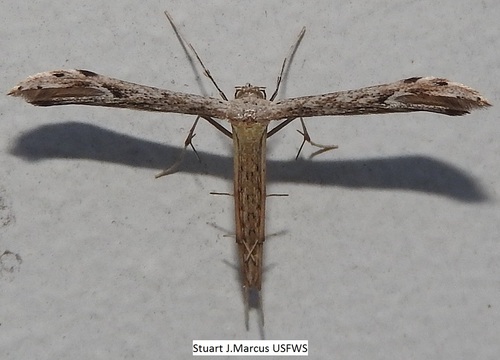


Belfrage'S Plume Moth
pselnophorus belfragei
The Belfrage's Plume Moth (Pselnophorus belfragei) is a fascinating nocturnal insect belonging to the Pterophoridae family, commonly known as plume moths. It is characterized by its uniquely divided wings, which give it a delicate, almost feather-like appearance. This small moth plays a subtle yet important role in its ecosystem, particularly through its larval stage which specializes in feeding on specific plants. Adults are often seen fluttering around at night, drawn to lights, and contribute to pollination as they visit various flowers for nectar.
Hábitat: Found in meadows, prairies, open woodlands, and disturbed areas where its host plants, primarily ironweed (Vernonia species), are abundant.
Belfrage's Plume Moth is a small, slender moth typically exhibiting a fawn or light brownish coloration. Its most distinctive feature is its deeply cleft wings; the forewings are divided into two lobes and the hindwings into three, giving them a feather-like or 'plumed' appearance. When at rest, it often holds its wings in a characteristic T-shape or rolled tightly, making it resemble a dried twig or piece of grass. Its body is delicate, and its legs are relatively long and thin.
Categoría
InsectosRareza
Common
Peligro
1/5 · Muy bajo
Snaps
¡Sé la primera persona en hacer un snap!
Belfrage's Plume Moth is named in honor of Gustaf W. Belfrage, a prominent Swedish entomologist who collected numerous insect specimens in Texas during the late 19th century.
Its larvae are extremely specialized, feeding exclusively on the reproductive structures of ironweed plants, demonstrating a tight ecological dependency.
The family name 'Pterophoridae' for plume moths is derived from Greek words meaning 'feather bearers,' a direct reference to their distinctive, deeply divided wings.
Unlike many other moths that fold their wings flat or tent-like, Belfrage's Plume Moth often rests with its wings rolled tightly along its body or extended outward in a characteristic 'T' shape, resembling a dried piece of vegetation.
When at rest, this moth often holds its deeply divided wings rolled or in a distinct 'T' shape, allowing it to blend seamlessly with dried plant material like twigs or dead leaves, providing effective camouflage from predators.
Its larval stage is highly specialized, feeding exclusively on the flower heads and developing seeds of various ironweed (Vernonia) species. This specific dietary requirement highlights a close ecological relationship with its host plant.
Adult Belfrage's Plume Moths are primarily nocturnal, actively visiting flowers under the cover of darkness to feed on nectar. This behavior contributes to the pollination of night-blooming plants in its habitat.
The larvae of Belfrage's Plume Moth are specialized herbivores, feeding on specific plant parts. Adult moths are nectarivores, consuming nectar from various flowers.
Diferencias por edad: Larvae feed exclusively on plant material, while adults primarily consume nectar.
Vernonia fasciculata
Larvae feed on its flower heads and seeds.
Myotis lucifugus
Adult moths are a food source for nocturnal insectivores.
Passer domesticus
Adult moths are a food source for diurnal birds.
Solidago canadensis
Adults visit its flowers for nectar, potentially aiding in pollination.
Aún no hay insignias de rasgos asignadas a este objeto.
Todavía no hay alias listados.
Las colecciones para este objeto aparecerán aquí a medida que se añadan más temas.
Peligro
1/5 · Muy bajo
Todavía no hay notas especiales de seguridad.
La forma más fácil de identificar a Belfrage'S Plume Moth es usar la aplicación de identificación de naturaleza Snappit.
1-2 cm
1-2 cm
0.0001-0.0003 kg
0 años
The larvae of Belfrage's Plume Moth are specialized herbivores, feeding on specific plant parts. Adult moths are nectarivores, consuming nectar from various flowers.
Found in meadows, prairies, open woodlands, and disturbed areas where its host plants, primarily ironweed (Vernonia species), are abundant.
Foraging
Acércate para separar los grupos y explorar dónde se ha fotografiado este objeto.
Los snaps recientes aparecerán aquí a medida que se añadan nuevas observaciones.















