

Bigcone Douglas-Fir
pseudotsuga macrocarpa
The Bigcone Douglas-Fir is a majestic and highly resilient evergreen conifer endemic to the rugged mountain ranges of Southern California. Standing tall against dry climates and steep terrains, this unique tree is a vital component of chaparral and montane mixed-forest ecosystems. Unlike many other conifers that succumb quickly to wildfires, the bigcone Douglas-fir has developed a remarkable ability to regenerate, helping it endure the region's frequent fire cycles. It serves as an ecological anchor, providing crucial shelter and nourishment for local wildlife. Finding one of these ancient sentinels on a rocky canyon slope is a breathtaking experience, offering a glimpse into California's botanical history.
Hábitat: Found on steep, rocky slopes and moist canyon floors within the montane coniferous forests and chaparral zones of Southern California.
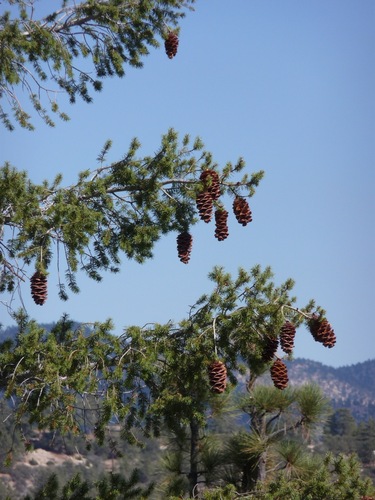
This medium to large tree typically grows between 15 to 44 meters tall, featuring a broad, open crown with long, sweeping horizontal branches. Its bark is exceptionally thick, dark brown, and deeply furrowed into rugged ridges, which helps protect the inner layers from heat. The needles are short, needle-like, and colored a soft blue-green to dark green, measuring about 2 to 5 centimeters. The most distinguishing feature is its massive, heavy cones, which can reach 10 to 18 centimeters in length, complete with thick scales and distinctive three-pointed bracts that protrude conspicuously.
Categoría
PlantasRareza
Common
Peligro
1/5 · Muy bajo
Snaps
¡Sé la primera persona en hacer un snap!
The bigcone Douglas-fir produces the largest cones of any Douglas-fir species, dwarf-ing those of its more famous cousin, the coast Douglas-fir.
The oldest known living specimen was verified to be over 620 years old, persisting through centuries of environmental shifts.
This species can survive fires that completely defoliate its canopy, growing entirely new branches from beneath its thick bark.
Unlike most other conifers, this species can resprout from epicormic buds along its trunk and branches after a fire has damaged its foliage.
Features a deep, extensive taproot system designed to anchor securely in steep, unstable rocky slopes and access deep subterranean water sources.
Produces massive, heavy, thick-scaled cones that protect its large seeds from heat and premature foraging until they are fully mature.
As a photosynthetic plant, the bigcone Douglas-fir produces its own food using sunlight, water, and carbon dioxide.
Otospermophilus beecheyi
The large, nutritious seeds of the bigcone Douglas-fir are a critical food source for small mammals like the California ground squirrel.
Quercus chrysolepis
Often associates closely with canyon live oak, which provides shade and microclimate protection for fragile young seedlings.
Aún no hay insignias de rasgos asignadas a este objeto.
Todavía no hay alias listados.
Las colecciones para este objeto aparecerán aquí a medida que se añadan más temas.
Peligro
1/5 · Muy bajo
Todavía no hay notas especiales de seguridad.
La forma más fácil de identificar a Bigcone Douglas-Fir es usar la aplicación de identificación de naturaleza Snappit.
1500-4400 cm
1000-20000 kg
100-620 años
As a photosynthetic plant, the bigcone Douglas-fir produces its own food using sunlight, water, and carbon dioxide.
Found on steep, rocky slopes and moist canyon floors within the montane coniferous forests and chaparral zones of Southern California.
Acércate para separar los grupos y explorar dónde se ha fotografiado este objeto.
Los snaps recientes aparecerán aquí a medida que se añadan nuevas observaciones.


















