

Bigfruit Evening Primrose
oenothera macrocarpa
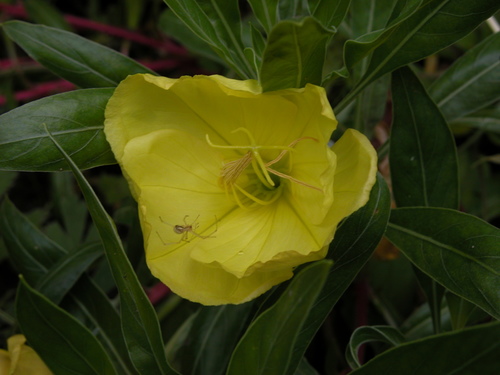
The Bigfruit Evening Primrose (Oenothera macrocarpa), also known as the Missouri evening primrose, is a stunning low-growing perennial native to the limestone glades and rocky prairies of central North America. This resilient plant is celebrated for its remarkably large, canary-yellow blossoms that open in the late afternoon and fade by the following day. These saucer-shaped flowers can reach up to five inches across, creating a dramatic visual impact against the plant's trailing, narrow green foliage. What makes this plant truly fascinating is its unique reproductive strategy and adaptation to harsh, rocky environments. Its flowers are specifically designed to attract nocturnal pollinators, such as sphinx moths, which are drawn to its sweet, delicate fragrance under the cover of night. Following pollination, it produces distinct, large, four-winged seed pods that give the plant its descriptive common name.
Hábitat: Found in rocky limestone glades, barren outcroppings, and dry, sandy prairies with excellent drainage and full sun exposure.
This low-growing, trailing perennial typically reaches heights of 15 to 30 centimeters but can spread up to 1 meter wide. It features lance-shaped, grey-green leaves with a prominent silver midrib. The most striking feature is the massive, bright yellow flowers, measuring 8 to 12 centimeters across, with four broad petals and prominent, long stamens. As the flowers age over their brief 24-hour lifespan, they transition to a soft orange or pinkish-apricot hue. Below the flowers, you will find conspicuous, papery, four-winged seed capsules that can grow up to 5 to 8 centimeters long, resembling miniature, winged lanterns.
Categoría
PlantasRareza
Common
Peligro
1/5 · Muy bajo
Snaps
¡Sé la primera persona en hacer un snap!
As the massive yellow flowers begin to fade the day after opening, they transform into beautiful shades of peach, orange, or light pink.
Its enormous, papery, four-winged seed pods can grow up to 8 centimeters long and are frequently used in dried floral arrangements.
The common name evening primrose is a bit of a misnomer, as this plant is not closely related to true primroses of the family Primulaceae.
Opens its massive yellow blossoms in the late afternoon and evening, perfectly timing its pollen availability with the activity of night-flying pollinators.
Possesses a deep, thick woody taproot that stores water and anchors the plant securely in rocky, thin limestone soils.
Produces unique, large four-winged seed capsules that catch the wind and help roll the pods across the ground to disperse seeds.
As a photosynthetic plant, it manufactures its own food using sunlight, water, carbon dioxide, and essential nutrients absorbed from the soil.
Hyles lineata
Pollinated by the White-lined Sphinx moth, which feeds on its nectar in the evening.
Schinia florida
The caterpillars feed on the leaves, buds, and seed pods of the plant.
Aún no hay insignias de rasgos asignadas a este objeto.
Todavía no hay alias listados.
Las colecciones para este objeto aparecerán aquí a medida que se añadan más temas.
Peligro
1/5 · Muy bajo
Todavía no hay notas especiales de seguridad.
La forma más fácil de identificar a Bigfruit Evening Primrose es usar la aplicación de identificación de naturaleza Snappit.
15-30 cm
3-10 años
As a photosynthetic plant, it manufactures its own food using sunlight, water, carbon dioxide, and essential nutrients absorbed from the soil.
Found in rocky limestone glades, barren outcroppings, and dry, sandy prairies with excellent drainage and full sun exposure.
Acércate para separar los grupos y explorar dónde se ha fotografiado este objeto.
Los snaps recientes aparecerán aquí a medida que se añadan nuevas observaciones.















