

Birdcage Evening Primrose
oenothera deltoides
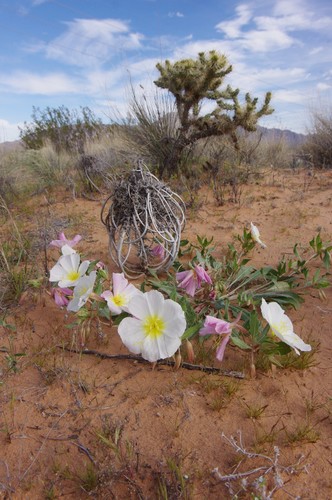
The Birdcage Evening Primrose (Oenothera deltoides) is an enchanting desert annual that brings spectacular life to the arid landscapes of the southwestern United States and northern Mexico. Flourishing in sandy dunes and desert flats, this resilient plant lies low to the ground as a leafy rosette before sending out sprawling stems crowned with large, showy blossoms. Its fragrant white flowers are beautifully adapted to nocturnal pollinators, opening dramatically at dusk and fading to a lovely pink hue by morning. What truly captures the imagination is the plant's unique life cycle: as dry summer heat sets in and the plant dies, its tough, woody stems curl upward and inward, interlocking to form a delicate, basket-like 'birdcage'. This dried frame often detaches from its taproot, transforming into a rolling tumbleweed that is propelled by desert winds, efficiently dispersing its seeds across the barren dunes to await the next spring rains.
Hábitat: Found on open, shifting desert sand dunes, sandy flats, and desert washes below 1,000 meters elevation.
This species is easily recognized by its large, four-petaled white flowers that measure up to 8 centimeters across, featuring a pale yellow center and prominent, hanging yellow anthers. The blossoms transition to a distinct light pink or purple color as they age and wilt. The plant's leaves are grayish-green, diamond-shaped (deltoid) with shallowly lobed or toothed margins, forming a low, spreading rosette close to the sandy ground. In its dead, dried state, the plant is identifiable as a light brown, woody, dome-like cage of arched branches reaching up to 50 centimeters in diameter.
Categoría
PlantasRareza
Common
Peligro
1/5 · Muy bajo
Snaps
¡Sé la primera persona en hacer un snap!
Its seeds can lie completely dormant in scorching desert sands for up to a decade, bursting into life simultaneously during rare 'superbloom' years.
The distinctive dried 'birdcages' left behind in summer can grow up to 50 centimeters wide, rolling across the sand dunes like miniature skeletal tumbleweeds.
The flowers of the Birdcage Evening Primrose undergo a rapid color change, blooming in pure white at dusk but fading to a deep pinkish-purple by the following afternoon.
Dried stems curl inward during death to form a strong, hollow tumbleweed structure that detaches and rolls, allowing wind-driven seed dispersal across sandy deserts.
Flowers open rapidly at dusk and emit a sweet fragrance to attract nocturnal hawk moths while avoiding daytime heat.
Seeds possess highly durable coats that allow them to remain dormant in parched desert soils for multiple years until sufficient rainfall triggers germination.
This plant is a photoautotroph that generates its own nutrients using sunlight, water, and carbon dioxide.
Hyles lineata
Serves as the primary nocturnal pollinator of the evening flowers.
Gopherus agassizii
Consumes the leafy rosettes and highly nutritious spring blossoms.
Pogonomyrmex desertorum
Collects and consumes the small seeds dropped by the rolling birdcages.
Aún no hay insignias de rasgos asignadas a este objeto.
Todavía no hay alias listados.
Las colecciones para este objeto aparecerán aquí a medida que se añadan más temas.
Peligro
1/5 · Muy bajo
Todavía no hay notas especiales de seguridad.
La forma más fácil de identificar a Birdcage Evening Primrose es usar la aplicación de identificación de naturaleza Snappit.
10-60 cm
1 años
This plant is a photoautotroph that generates its own nutrients using sunlight, water, and carbon dioxide.
Found on open, shifting desert sand dunes, sandy flats, and desert washes below 1,000 meters elevation.
Acércate para separar los grupos y explorar dónde se ha fotografiado este objeto.
Los snaps recientes aparecerán aquí a medida que se añadan nuevas observaciones.













