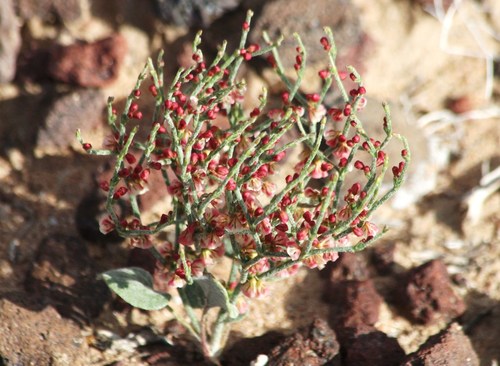


Birdnest Buckwheat
eriogonum nidularium
The Birdnest Buckwheat (Eriogonum nidularium) is an intriguing annual wildflower native to the arid desert regions of the southwestern United States. Growing in sandy flats and rocky washes, this hardy plant has adapted beautifully to some of the harshest climates in North America. Its most fascinating trait occurs late in its life cycle: as the plant dries out, its highly branched, delicate framework curls inward to form a tight, hollow ball that remarkably resembles a tiny bird's nest. During its active growing season, this desert survivor produces dense webs of yellow, white, or pink blossoms that provide vital nourishment to local insect pollinators. It plays a subtle yet key role in desert ecology, holding loose soils together and providing a seasonal seed harvest for native rodents.
Hábitat: Found in open desert flats, sandy washes, and gravelly slopes, often within sagebrush scrub and pinyon-juniper plant communities.
Birdnest Buckwheat is a small annual herb, typically standing between 5 to 30 centimeters tall, featuring a highly branched, skeleton-like structure. Its small green leaves are mostly clustered at the base, while the stems can range in color from pale green to a deep, sunburned reddish-purple. The tiny, bell-shaped flowers, which lack true petals, are clustered in the forks of the branches and display shades of yellow, white, or soft pink. As the plant matures and dries, the entire structure transitions to a rusty, reddish-brown or gray color and curls tightly inward into its signature spherical, nest-like shape.
Categoría
PlantasRareza
Common
Peligro
1/5 · Muy bajo
Snaps
¡Sé la primera persona en hacer un snap!
The species name 'nidularium' is derived from the Latin word for 'little nest,' direct evidence of its iconic dried form.
The tiny flowers lack true petals; instead, they have colored sepals that mimic petals to attract insect pollinators.
Though it looks fragile, the dried 'birdnest' structure can withstand rolling over rough desert terrain for weeks without completely breaking apart.
Upon dying, the branches dry and curl inward to form a protective hollow sphere, which shields mature seeds from extreme weather and predators.
Produces high concentrations of red-purple pigments that act as a natural sunscreen, protecting the plant from intense ultraviolet radiation.
The dried, spherical skeleton easily detaches from its shallow root, tumbling across the desert floor with the wind to widely disperse its seeds.
As a photoautotrophic plant, it produces its own organic compounds and energy through photosynthesis, using sunlight, carbon dioxide, and water.
Apis mellifera
Bees visit the abundant tiny flowers of birdnest buckwheat for nectar, acting as primary pollinators.
Apodemia mormo
The caterpillar of this butterfly species feeds on the foliage and flowers of various wild buckwheats.
Dipodomys merriami
Desert rodents forage for and consume the abundant seeds dropped by the mature dried plant.
Aún no hay insignias de rasgos asignadas a este objeto.
Todavía no hay alias listados.
Las colecciones para este objeto aparecerán aquí a medida que se añadan más temas.
Peligro
1/5 · Muy bajo
Todavía no hay notas especiales de seguridad.
La forma más fácil de identificar a Birdnest Buckwheat es usar la aplicación de identificación de naturaleza Snappit.
5-30 cm
0.001-0.05 kg
1 años
As a photoautotrophic plant, it produces its own organic compounds and energy through photosynthesis, using sunlight, carbon dioxide, and water.
Found in open desert flats, sandy washes, and gravelly slopes, often within sagebrush scrub and pinyon-juniper plant communities.
Acércate para separar los grupos y explorar dónde se ha fotografiado este objeto.
Los snaps recientes aparecerán aquí a medida que se añadan nuevas observaciones.




_(8592459332).jpg&width=800)











