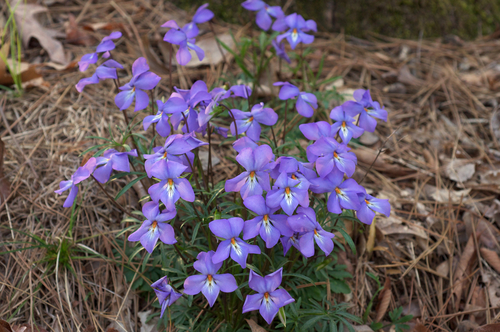


Bird'S Foot Violet
viola pedata
The Bird's Foot Violet (Viola pedata) is a striking North American wildflower that gets its unusual common name from its distinctive, deeply divided leaves, which closely resemble the toes of a bird. Unlike many familiar woodland violets that thrive in moist, shady environments, this robust perennial prefers the harsh conditions of dry, sandy, and rocky soils under open sun. It is highly sought after by native plant enthusiasts and botanists alike for its spectacular spring blooms, which are noticeably larger and showier than those of most other violet species. What truly sets the Bird's Foot Violet apart is its specialized biology. It lacks the hidden, self-pollinating (cleistogamous) flowers that most other violets use as a reproductive backup, making it entirely dependent on spring insects for pollination. With its stunning floral displays—which sometimes feature a dramatic two-toned color pattern of dark velvet and pale lilac—and its critical role in supporting rare fritillary butterfly caterpillars, it stands out as an ecological gem of dry prairies and open woodlands.
Hábitat: Found in dry, open woodlands and sunlit prairies, often growing in well-drained, sandy or rocky soils.
The Bird's Foot Violet is a low-growing herbaceous perennial reaching only 10 to 25 centimeters in height. Its most identifying feature is its pale green leaves, which are palmately divided into narrow, linear segments that look like a bird's foot. In mid-spring, it produces large, flat-faced, five-petaled flowers up to 4 centimeters across, featuring a conspicuous bright orange stamen tip in the center. The blooms appear in two distinct color forms: 'concolorous' (where all five petals are a uniform light blue-violet or lilac) and 'bicolored' (where the two upper petals are a rich, dark, velvety purple, and the lower three petals are a lighter lilac).
Categoría
PlantasRareza
Common
Peligro
1/5 · Muy bajo
Snaps
¡Sé la primera persona en hacer un snap!
It gets its scientific name, 'pedata' (meaning 'foot-like'), directly from the deeply cut, narrow lobes of its leaves which mimic the branching toes of a bird.
It requires occasional wildfires in its natural habitat to clear away competing plants and excess shade, allowing its sun-loving rosettes to thrive.
Its seeds are 'planted' by ants! The seeds sport a lipid-rich appendage called an elaiosome that ants find irresistible; they carry the seed underground, eat the snack, and leave the seed intact to germinate.
Unlike most other North American violets, which are considered weeds in manicured lawns, the Bird's Foot Violet is highly sensitive to habitat changes and rarely survives in typical suburban lawns.
It possesses a thick, fleshy taproot that allows it to store water and survive in exceptionally dry, sandy, or rocky soils where other violets would wither.
When the seed capsules mature and dry out, they split open explosively, shooting seeds a short distance away from the parent plant to reduce local competition.
Unlike most Viola species, it does not produce self-pollinating, hidden flowers, forcing it to rely entirely on visiting insect pollinators to ensure genetic diversity.
Like most plants, the Bird's Foot Violet is a photoautotroph that creates its own food through photosynthesis using environmental resources.
Speyeria idalia
Caterpillars feed exclusively on the leaves of this and other violets.
Bombus pensylvanicus
Forages for nectar and inadvertently transfers pollen between flowers.
Aphaenogaster rudis
Disperses the violet's seeds by carrying them back to their nests to eat the fleshy elaiosome attached to the seed.
Aún no hay insignias de rasgos asignadas a este objeto.
Todavía no hay alias listados.
Las colecciones para este objeto aparecerán aquí a medida que se añadan más temas.
Peligro
1/5 · Muy bajo
Todavía no hay notas especiales de seguridad.
La forma más fácil de identificar a Bird'S Foot Violet es usar la aplicación de identificación de naturaleza Snappit.
10-25 cm
3-10 años
Like most plants, the Bird's Foot Violet is a photoautotroph that creates its own food through photosynthesis using environmental resources.
Found in dry, open woodlands and sunlit prairies, often growing in well-drained, sandy or rocky soils.
Photosynthesis
Acércate para separar los grupos y explorar dónde se ha fotografiado este objeto.
Los snaps recientes aparecerán aquí a medida que se añadan nuevas observaciones.
Arkansas, US
Puedes ver Bambú Celestial, Lagartija De Pradera y Acederilla Violeta.
Ver guía →

Wisconsin, US
Puedes ver Green Comet Milkweed, Lirio De Bosque y Flowering Spurge.
Ver guía →

Missouri, US
Puedes ver Roble Negro, Bird's Foot Violet y Starry Campion.
Ver guía →

Georgia, US
Puedes ver Jicotea Elegante y Laurel De Montaña.
Ver guía →

Wisconsin, US
Puedes ver Sundial Lupine, Aurora Damsel y Lancet Clubtail.
Ver guía →

Georgia, US
Puedes ver Jicotea Elegante y Laurel De Montaña.
Ver guía →




.jpg&width=800)









.jpg&width=800)




