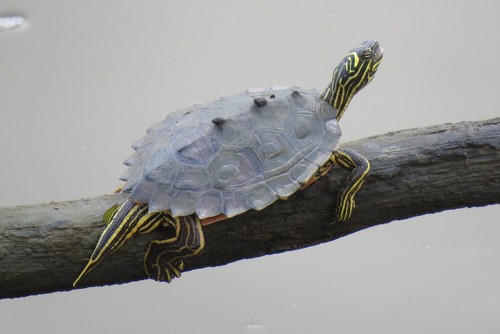


Black-Knobbed Map Turtle
graptemys nigrinoda
The Black-Knobbed Map Turtle is a striking and highly specialized aquatic turtle endemic to the Mobile Bay drainage system in Alabama and Mississippi. Named for the prominent, dark, bulbous spines protruding from its vertebral scutes, this medium-sized turtle is a favorite among herpetologists and wildlife observers. It spends a massive portion of its day basking on fallen logs and branches hanging over fast-flowing rivers. This species is highly adapted to riverine environments, displaying exceptional swimming capabilities and a specialized diet that helps keep river ecosystems balanced. Due to its limited geographic range and sensitivity to water pollution, it serves as an important indicator species for the health of freshwater systems in the southeastern United States.
Hábitat: Found in moderate to fast-flowing river systems, particularly those with clay or sandy bottoms and abundant basking sites like fallen trees and brush piles.
This turtle is easily recognized by the 2 to 4 black, knob-like projections on the center of its carapace, which resemble a miniature mountain range. The carapace itself is olive-brown to dark green, featuring fine, yellow-to-orange circular markings on each scute that resemble a map. The plastron is yellow with a bold, dark pattern along the seams. Its head, neck, and limbs are dark grey or black, decorated with vibrant yellow stripes, including a distinctive yellow crescent behind each eye. Females are significantly larger than males, reaching up to 22 cm in carapace length, while males rarely exceed 12 cm.
Categoría
ReptilesRareza
Common
Peligro
1/5 · Muy bajo
Snaps
¡Sé la primera persona en hacer un snap!
The prominent black spikes on their shells tend to wear down and become more rounded or flattened as the turtle ages.
The species exhibits temperature-dependent sex determination, meaning the temperature of the nest decides whether the hatchlings are male or female.
They are incredibly shy baskers; they will dive into the river at the slightest shadow, sound, or movement from hundreds of feet away.
Its streamlined shell and protruding vertebral knobs help break water tension, allowing the turtle to navigate fast-flowing river currents with ease.
They possess an acute ability to regulate body temperature by balancing extensive basking sessions on elevated logs with quick plunge-dives into cool river waters.
Adult females develop broad, flat alveolar surfaces on their jaws, which allow them to effortlessly crush hard-shelled mollusks and snails.
This species primarily feeds on freshwater sponges, bryozoans, aquatic insects, and small mollusks. Females, with their larger jaws, consume more hard-shelled prey than males.
Diferencias por edad: Juveniles and adult males feed heavily on soft-bodied aquatic insects, while mature females shift their diet toward larger, hard-shelled mollusks and snails due to their increased jaw size.
Corbicula fluminea
Preys upon freshwater bivalves and snails in river beds.
Procyon lotor
Eggs and hatchlings are heavily preyed upon along the sandy riverbanks.
Pectinatella magnifica
Feeds extensively on bryozoan colonies growing on submerged wood.
Aún no hay insignias de rasgos asignadas a este objeto.
Todavía no hay alias listados.
Las colecciones para este objeto aparecerán aquí a medida que se añadan más temas.
Peligro
1/5 · Muy bajo
Todavía no hay notas especiales de seguridad.
La forma más fácil de identificar a Black-Knobbed Map Turtle es usar la aplicación de identificación de naturaleza Snappit.
7-22 cm
0.1-1.2 kg
15-30 años
12 km/h
This species primarily feeds on freshwater sponges, bryozoans, aquatic insects, and small mollusks. Females, with their larger jaws, consume more hard-shelled prey than males.
Found in moderate to fast-flowing river systems, particularly those with clay or sandy bottoms and abundant basking sites like fallen trees and brush piles.
Foraging
Acércate para separar los grupos y explorar dónde se ha fotografiado este objeto.
Los snaps recientes aparecerán aquí a medida que se añadan nuevas observaciones.




_-_Flickr_-_GregTheBusker.jpg&width=800)







_-_Flickr_-_2ndPeter.jpg&width=800)